
As we all know, augmented reality and virtual reality technologies combine the digital world with real events. This technology gives users to experience imagine digital world.
In 2023 more than 110 million people in US are using the augmented and virtual reality. It lets you show the fast growth of these technologies.
Explain the difference of Augmented Reality and Virtual Reality because they share same features and uses. That’s why, many people use this technology.
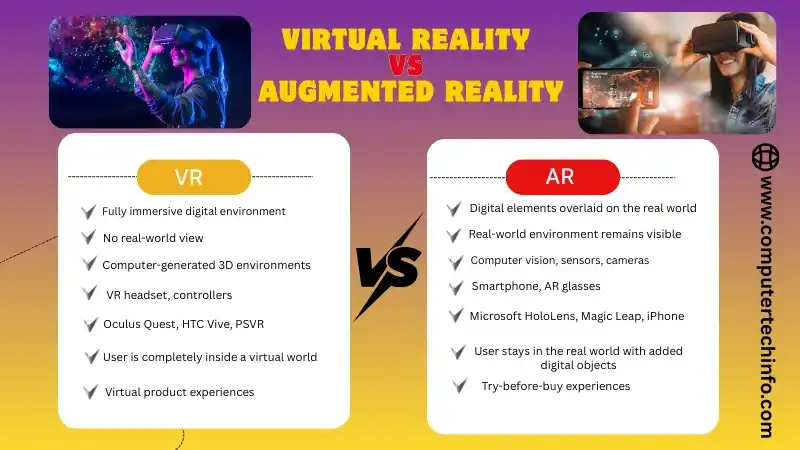
In this article, we cover the basics of Augmented Reality and Virtual Reality, explain their differences, examples and cover their future possible.
What is about Augmented Reality?
Augmented Reality set digital learning information, pictures, sounds, and 3D graphics on top of the real world in real time to change how people see the real world.
The first working AR systems that let users experience mixed reality appeared in the early 1990s, such as Virtual Fixtures at the US Air Force Armstrong Lab in 1992.
Before, it was only using for fun and entertainment. Then, it started being used in business and schools. As we all understand technology allows students to learn anytime and anywhere.
What is Virtual Reality?
As we all know virtual reality makes digital 3D world for people look environment. It uses devices like goggles, headsets, gloves, or suits.
It started in 1968 with work by Ivan Sutherland and Bob Sproull. So, it became well-known in the late 1980s thanks to Jaron Lanier. It is now common in video games and also being used in schools.
It can be part of a game and also helps students learn hard concepts.
Difference between Augmented Reality and Virtual Reality in Tabular
| Feature | Virtual Reality (VR) | Augmented Reality (AR) |
| Meaning | Creates a completely artificial digital environment | Adds digital elements to the real world |
| User Environment | Fully immersive, blocks out real world | Real world remains visible with virtual overlays |
| Devices Used | VR headsets (Oculus, HTC Vive, PS VR) | Smartphones, tablets, AR glasses (HoloLens) |
| Interaction | Users interact in a fully virtual space | Users interact with both real and virtual objects |
| Level of Immersion | Very high | Moderate |
| Applications | Gaming, simulations, training, virtual tours | Navigation, education, retail, medical visualization |
| Real-World Awareness | No awareness of physical surroundings | Full awareness of surroundings |
| Cost | Generally Higher | Generally Lower |
| Example | Virtual game worlds, flight simulators | Pokémon Go, Snapchat filters |
Key Differences: AR vs VR with Examples
As told you above; both are work for different purpose. Augmented Reality and Virtual Reality both offer attractive experiences.
1. Environment
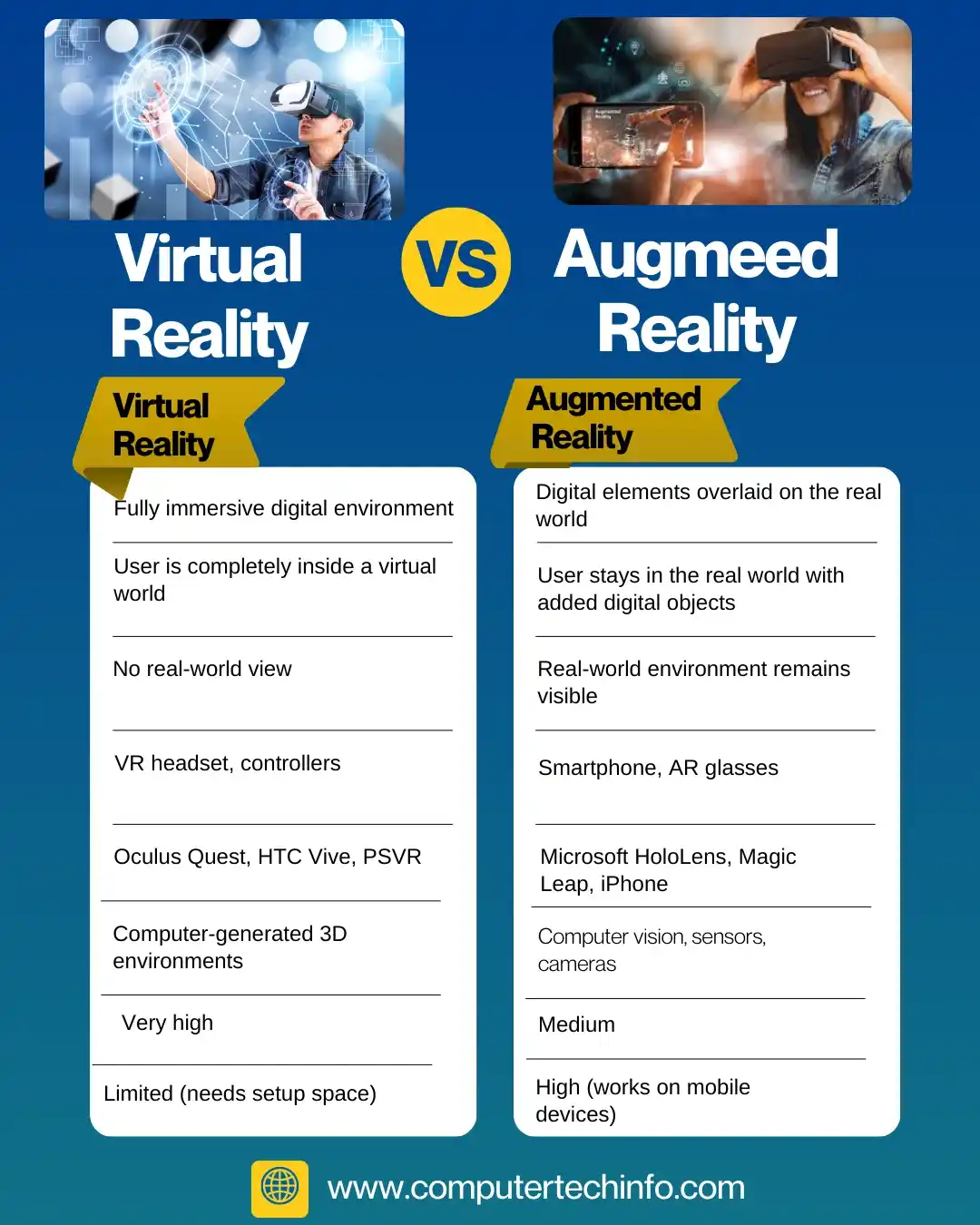
AR: In augmented reality adds digital part to the real world, allowing users to interact with both physical and virtual surrounding simultaneously.
VR: In virtual reality set you in a fully digital surrounding, where the real world disappears. And, you can interact only with the virtual space.
2. Interaction with Reality
AR: This allows you to interact with both digital and real-world elements together. For example, you can see and control virtual objects that placed within your real environment.
VR: Its limits interaction to the virtual environment only. All actions and interactions occur within the digital world, without involving the physical world around you.
3. Equipment Required
AR: In augmented reality, you can easily interact with digital objects in real world by using phones, tablets, or AR glasses.
VR: But, here virtual reality shows the virtual world with using some special tools like as Oculus Rift, HTC Vive, or PlayStation headsets.
4. Level of Immersion
AR: In Augmented Reality gives a partly engaging experience by adding digital elements to the real world. So, you can still see and notice your background.
VR: Virtual Reality allows fully dip you by hiding the real world, making you feels like you are inside a virtual world.
5. Use Cases
AR: As we all know gaming, shopping, education, and helping workers are using in augmented reality.
VR: As we all know gaming, training simulations, virtual tourism, and medical therapy are using in virtual reality.
6. Accessibility
AR: Next one, it is easier for most people to use because it works on devices; they already have, like phones and tablets.
VR: Here, virtual reality needs costly tools and strong computer or gaming support because it is harder to use.
7. Impact on User Experience
AR: It improves real-world experiences by adding useful digital content and interactive elements. This is done with keeping the aware of your surroundings.
VR: It allows you to a fully digital world, letting you experience things that you can’t in real life. But, you are cut off from the real world.
On the bases of these things; you can decide which one fits your needs. This is whether to improve the real world with digital elements or experience a fully virtual world.
Mixed Reality (MR): Combining AR and VR Technologies
As we shown above, Mixed Reality combines Augmented Reality and Virtual Reality to create a surrounding where real and digital objects exist together and interact in real time. It shows digital content on top of the real world and it creates a completely virtual environment.
Mixed Reality however it allows users to interact with both real and virtual elements together.
It is possible because of advanced sensors, processors, and displays found in devices such as Microsoft’s HoloLens. They not only understand the user’s physical environment but also allow real and virtual objects to interact.
In a Mixed Reality app, a virtual object may look like it is placing on a real table and can react to how the user moves.
In this combination allows users in education, design, healthcare, and entertainment to work with virtual elements while staying connected to the real world.
Future of AR and VR
There is different reports estimate where the global AR and VR market will be in the future. In statista reports; everywhere augmented reality is presenting. But, virtual reality market will grow to $350.9 billion U.S. dollars in 2026.
Augmented Reality technology was most widely using in industrial and manufacturing sector in 2021 that making up 24.3% of the market. And, it is expected to keep dominating in the coming years.
Now these days, virtual reality is growing strongly in gaming areas. But, Augmented Reality is mainly applying in industrial and enterprise environments to support on-site work and digital transformation. Many businesses are aim to use AR as part of their Industry 4.0 operations.
Ending Thoughts
Augmented Reality creates 3D simulations and can serve different functions. Digital overlays help people do real-world tasks in a more interactive way. VR is a digital technology that fully immerses users for learning.
Augmented Reality and Virtual Reality have become widely used in education, health, business, and entertainment. The difference is that Augmented Reality and Virtual Reality take digital experiences into education, work, and daily life.
![Mani Cab Service in Yamunanagar | Taxi Service [7056323200]](https://computertechinfo.com/wp-content/uploads/2025/10/Mani-Cab-Service-in-Yamunanagar.webp "Mani Cab Service in Yamunanagar | Taxi Service [7056323200]")

