
Let us discuss about GPU architecture refers to the structure and function of a graphics processing unit. We are describing how the components of a GPU are getting to structure to increase its performance.
Other side CPUs get mainly focusing on following tasks, GPUs are capable of manage big data sets together between parallel processing. This builds it perfect like applications such as gaming graphics, AI training, and data visualization.
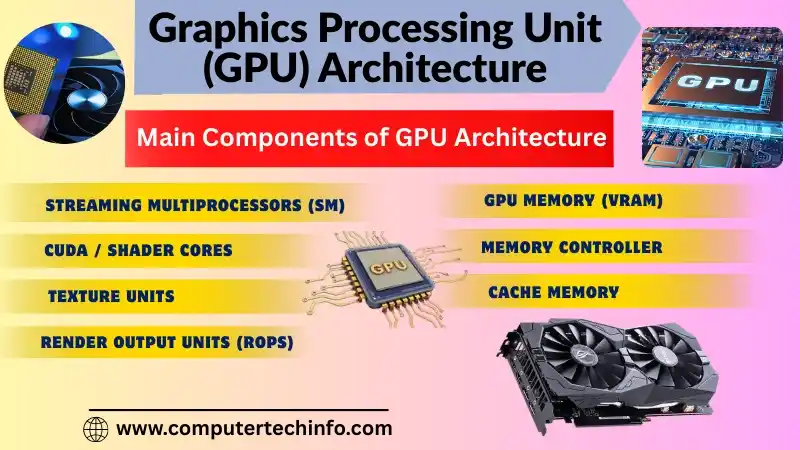
Now we talking about what are GPU architecture and its purpose, components, and how it has evolved.
Evolution of GPU Architecture
In the early time graphics card were mainly designing for rendering simple 2D graphics. GPUs have seen vast progress and growth over time. The growing need for better visual experiences led to the development of more modern and sophisticated GPU architectures.
Also Read: What is Difference Between CPU and GPU? GPU Vs CPU
As we know, earlier GPU were limited fixed function pipeline, focusing only on rendering tasks. Introduction of programmable shades by companies like NVIDIA and AMD, GPUs could manage more complex computing tasks beyond graphics.
In these years, like Intel brands also come the GPU market, pushing the limits of GPU computing capacity with innovation design tailored for data centers and AI workloads.
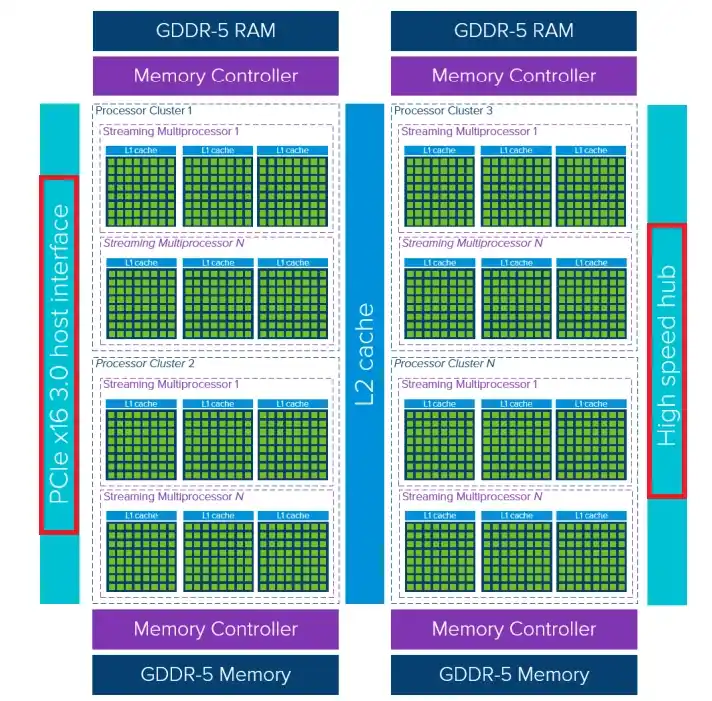
As we know today’s GPUs are create on highly advanced architecture, using parallel processing unit, shader cores and expert hardware for ray tracing and AI acceleration.
GPU Architecture Component
There are some essential key components that are using in GPU architecture, like as:
Graphics Memory Controller
The graphics memory controller, or even time called an MCU/MCC, is the digital circuit that controls the data flowing between the CPU and graphics memory. The GMC is sometimes a separate chip, but it may also be add into another chip, such as on the same die with the processor or as part of the processor. When the GMC added in the processor, then called the IMC. It manages VRAM, DDR, GDDR, and other types of graphics memory.
Graphics Compute Array
Now we are talking about graphics compute array (GCA) or 3D engine is responsible for generating and displaying 3D graphics. The graphics compute array consists of many parts, such as pixel and vertex shades, CUDA cores, texture mapping units; render output units, geometry processors, and L2 cache.
Bus Interface
Let us discuss the bus interface connects different parts of the GPU and transfers data between them. Bus interfaces communicate with smaller peripheral devices, such as flash memory, through the processor. Common examples are VLB, SA, PCI, PCIe, and AGP.
Power Management Unit
The power management unit is a chip that monitors and controls how much power the graphics processor is using. The PMU acts as a miniature system containing essential components such as memory, CPU, software, and firmware. It is one of the limited components that remain operational after a system shutdown, powered by a backup power source.
Also Read: CPU Register and its Types with its Functions
As we know the PMU performs many power-related tasks inside the laptop. It monitors the battery’s charging, shuts down components when not needed, manages sleep mode, and runs the clock (RTC).
Video Processing Unit
VPU is a special type of processor that takes video as input and performs various and complex tasks on it. Video processing units (VPUs) are using in machine learning devices and help encode or decode video. Because of this, the VPU is called a video encoder/decoder and can compress or decompress video in formats such as Theora, H.264, H.265, VP8, VP9, MPEG-2, and VC-1.
Display Interface
Now we are discuss about the display interface (DIF) that also called the shows controller. It controls how data is sent and received between the host, the image data source, and the display device. The interface transfers data to the display and supports HDMI, DP audio, RAMDAC, video underlay, PHY, and EDID.
If GPUs have more cores than CPUs and a simpler design, then it’s allowing them to perform multiple tasks in parallel. This type of processor has name the GPGPU. It helps speed up computational tasks in HPC.
How Does a Graphics Processor Work?
As we know GPU is a special electronic chip, the main function of which is to process graphics and visual data faster. These processors are helpful in processing many pieces of data at the same time, to make them functional for video editing, machine learning and gaming application. This data add every pixel of the image, its color and its position on the display.
Also Read: What is CPU? Components, Parts of CPU and their Functions
Now we are talking about so it converts the image into an analog signal. In order to show the image in analog form the random access memory is connecting directly convert digital to analog. Here, many system are adding the above one RAM-DAC that can Improve performance and support using the above one monitor?
So, we discuss about this frame rate states how many time finish images can be giving on display for each second. As we know the human eye processes around 25 frames for each second but fast action games should process a minimum of 60 frames for each second to give a smooth game scroll and flow.
FAQs (Frequently Asked Questions)
What Is GPU Architecture?
GPU architecture describes how the components of a graphics processing unit cores, memory, and cache are organized for parallel processing.
How Is Gpu Architecture Different From Cpu Architecture?
GPUs handle parallel tasks with many small cores; other side CPUs handles sequential and complex tasks with fewer, but more capable cores.
What Are Cuda Cores / Stream Processors?
GPU cores run instructions in parallel and more cores improve performance in graphics and AI.
What Is The Role Of Memory In Gpu Architecture?
Graphics and compute data are held in the GPU’s VRAM. It is high bandwidth memory is needs like fast core memory transfers.
Why Is Gpu Architecture Important For Ai And Gaming?
Because it’s massively parallel design accelerates:
Real-time graphics rendering (gaming)
Matrix operations (AI/ML)
Scientific simulations
Video processing
Verdict Up
Let us understand whether you are into gaming, AI research, or cloud-based tasks, understanding GPU architecture determines how efficiently the hardware’s capabilities will be utilizing. Its architectural features such as CUDA cores, Tensor cores, and GPU virtualization directly impact performance.
As we know GPUs focus on parallel processing, CPUs on sequential tasks. GPUs from NVIDIA, AMD, and Intel are going to gear towards a variety of needs, from gaming to AI training and data center workloads.
If when you are choosing a new GPU. Then consider factors like price, power efficiency, and multi-GPU support to make the right decision.


