In the today world, Graphics processing unit (GPU) is important for the visuals and computing operations that power numerous technologies, from smart phones to sophisticated artificial intelligence applications.
Mainly this designed to render for videos games. Now the GPUs are using for many more features than just their real purpose. They have change into complex systems capable to handling data processing.
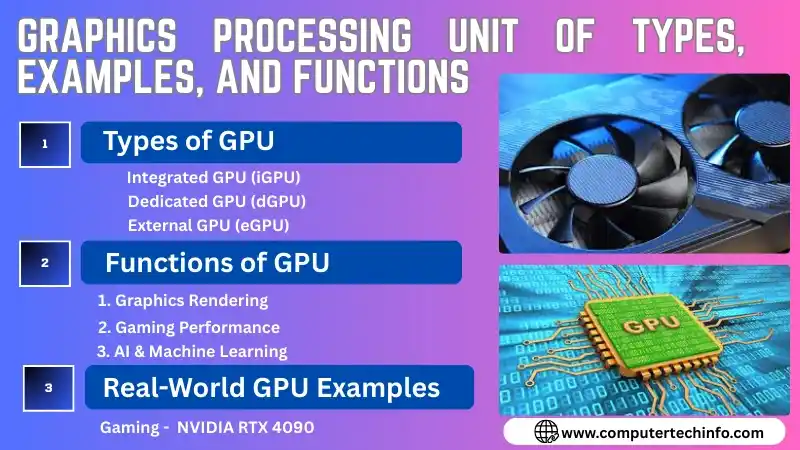
Let us discuss what is a GPU and how does it work? Read on to understand the working and uses of GPU!
What is a GPU (Graphics Processing Unit)? Definition
Now we talking about GPU is a hardware chip that quickly renders images and videos displayed on the screen. Nowadays, it is using not only for games and graphics; but also for advanced tasks like AI, machine learning, and big data processing.
Like images and graphics are displayed on screen. It is a complex mathematical calculation. A GPU can perform this calculation at high speed.
While a GPU can handle many similar tasks simultaneously. A CPU works on fewer tasks at a time. Through parallel processing graphics makes better and smoother.
Graphics Processing Unit (GPU) History
As we know, Nvidia GPU released by GeForce 256, in 1999 that was the first widely available GPU. It defined as a chip that could handle multiple graphics tasks together and fast process millions of polygons. This creates 3D gaming smoother and efficient than ever before.
Also Read: Graphics Processing Unit (GPU) Architecture Diagram with Example
While technology kept improving, and Nvidia’s GeForce 8800 GTX was a very powerful GPU of its time. It’s capable of processing textures very fastest and significantly increases gaming performance.
In today’s time, the popularity of GPUs has rapidly increased again. Due to the development of artificial intelligence and crypto currencies, their use has started expanding into new areas. Along with, GPUs also play important role for generating higher quality virtual reality gaming.
What Are The Different Types Of GPUs?
There are three types of GPUs:
Discrete GPUs
A discrete GPU (dGPU) is a graphics processor that is separate from the CPU and performs its processing work independently.
This processes the graphics data coming into the device on its own that improves the computer’s performance. A GPU is a separate graphics card that uses for heavier graphics tasks and is connected to the computer through an Express slot.
As we know Intel Arc is a popular discrete graphics card series. Its specifically designed for better performance in PC gaming.
Integrated GPUs
An integrated GPU (iGPU) is built into the hardware of computer or device and is usually attached alongside the CPU.
iGPUs developed by Intel in the 2010s became more popular, as manufacturers like MSI, ASUS, and Nvidia found that integrating a GPU with the CPU is more useful and cost-effective in many cases, rather than having users install a separate GPU in a PCI Express slot.
It is a good option for laptop users, casual gamers, and those who run heavy computational programs on their PC but do not want to install a separate graphics card.
Virtual GPUs
Virtual GPUs, also called vGPUs that provide the same performance and functionality as traditional GPUs, but they are in entirely software-based. They are specifically developing for cloud instances to execute similar types of computational workloads. Due to the absence of hardware, their maintenance is simpler and more cost-effective compared to physical GPUs.
GPU and CPU: Working Together
As everyone knows CPU and GPU complement each other.
The CPU handles general tasks and keeps accelerating, while the GPU designed for graphics and gaming.
Knowing their roles makes choosing a system easier. Get to know in detail follow this Graphics Processing Unit Architecture
Examples of GPU Usage
Gaming: It’s showing complex 3D graphics, lighting, and textures directly.
Machine Learning/AI: It trains AI models quickly by performing multiple tasks fastest.
Content Creation: With using of amazing tools like Blender or Premiere; you can make videos and 3D designs as appealing.
Scientific Simulation: It is also using for study about weather or look at medical images.
External Graphics Processing Unit (GPU)
Now we talking about GPUs are externally connected to laptop computers. Laptops have a good amount of RAM and powerful CPU. Like a large external hard drive, this graphics processing unit is also located outside the computer unit.
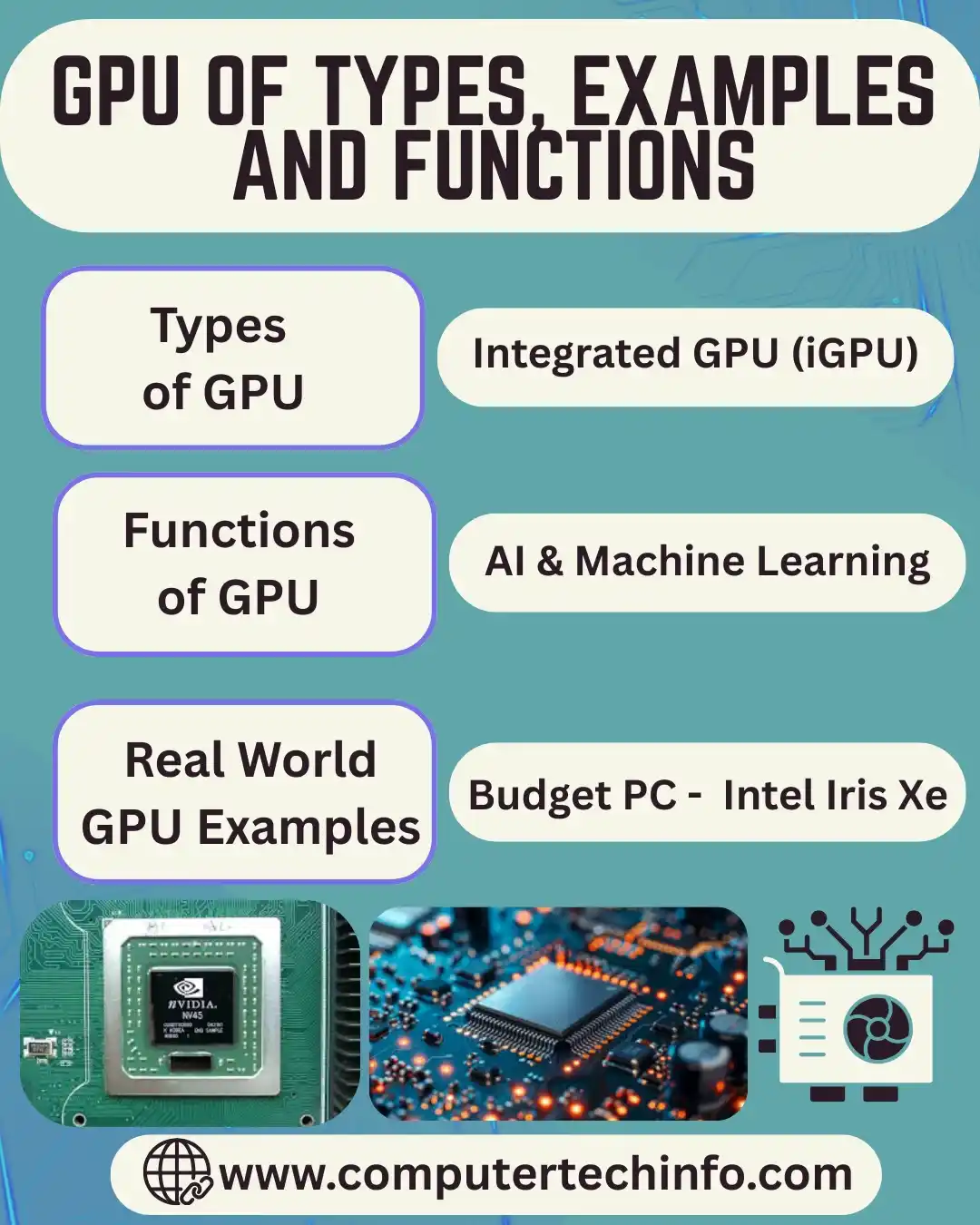
As we know laptops typically have lightweight, low-power graphics chips. These can handle basic tasks, but aren’t sufficient for high-end games. Therefore, an external GPU is using with the laptop to achieve better performance.
As the demand for better graphics and higher image decision increases, the need for more powerful GPUs is also growing. With powerful GPUs available, significant progress is possible in advanced processing technologies like machine learning and deep learning.
The fast growth of the gaming industry has seen a significant contribution from GPUs. Many advanced graphics games take full advantage of the GPU’s capabilities. How can an external GPU be connecting to a laptop?
Difference between GPU and CPU
As we know the central processing unit is the brain of your computer that handles the systems all operation. The operating system is running to manage application, executing input or output task and handling multitasking.
Also Read: What is Difference Between CPU and GPU? GPU Vs CPU
CPUs have fewer cores, designed for sequential processing. This refers to taking up one task at a time.
On the other hand the graphics processing unit is like a powerhouse with thousands of smaller cores. This is important for demanding jobs like rendering graphics, videos editing, powering AI and machine learning.
What are Advantages and Disadvantages of GPUs?
Here, we are going to cover several advantages and disadvantages in detail; including:
Advantages of GPUs:
Energy efficiency: GPUs can prove to be more energy efficient and higher performing than CPUs for some workloads, such as supercomputer and data center applications.
Scalability: Its using multiple GPUs makes the work faster.
Cost-effective solutions: GPUs can perform many computational tasks inexpensively, without requiring a dedicated machine.
Disadvantages Of GPUs:
Limited Single-Thread Performance: While GPUs are faster at parallel processing. Their individual cores are not as powerful as CPUs at single threaded tasks.
Memory Constraints: GPUs don’t have as much space as RAM, so large data tasks may be limited.
Programming Complexity: Using GPUs correctly requires advanced coding knowledge.
Compatibility And Driver Issues: For better performance, it is important to keep the GPU drivers updated, otherwise some apps may face problems.
Not Universally Beneficial: There are some tasks that perform better on the CPU rather than the GPU.
GPUs Applications and Uses
Now we talking about GPUs were initially intended solely for gaming. But, they are now being used in various industries and research. Here are some uses and application:
Gaming: As we know the games run faster and show better image with help of GPU.
Artificial Intelligence (AI) and Machine Learning (ML): GPUs can perform multiple computing tasks fastly. So their use has increased in AI and machine learning
Scientific Computing: As we know GPUs are using for complex scientific simulations and learning large data sets.
Cryptocurrency Mining: Power of GPUs comes in handy in both crypto mining and healthcare research, as it can perform heavy calculations quickly.
Is a GPU a Graphics Card?
Now discuss people often use GPU and graphics card interchangeably, but there is a difference. A GPU is a hardware chip itself, which is sometimes part of a graphics card or can be installing in a different type of card.
Also Read: CPU Register and its Types with its Functions
As we know a GPU card or video card is an extended part of a computer that contains the GPU, VRAM, cooling, and other components needed to display graphics.
The graphics card connects to the motherboard in the computer and has ports for the monitor or display.
GPU Functions
Graphics processing units perform many essential functions that you should be knowing, like as:
Rendering Graphics: Allows creating and displaying 2D and 3D graphics as video and animation.
Parallel Processing: With performing many tasks simultaneously, it completes entire work quickly.
Shading & Texturing: It generate the 3D images look realistic with helping of light, color, and texture
Image & Video Processing: It processes the video and makes it look good and clear.
Scientific & Mathematical Computation: GPU also help to execute all complex calculations fastest for simulations and research.
FAQs (Frequently Asked Questions)
What are GPUs Being Used For?
As we know GPUs are special processors that are fast at parallel tasks. Originally, it is using for gaming and 3D graphics. So, now they are also essential for AI, machine learning, and big data.
Is A GPU Better than a CPU?
The CPU runs the system, and the GPU performs complex and computational tasks fastest.
Is GPU a Type of RAM?
The GPU stores the necessary information in its memory and uses it when needed.
What is the GPU of a Laptop?
The GPU in Windows helps render images and effects on the computer screen.
Why is GPU Used in AI?
GPU or graphics card makes graphics and effects work faster and smoother.
Bottom Words
At the final, GPUs are most important for AI because they can accelerate the training and inference processes. GPUs allow AI models to be developed and deployed more fast and efficiently than CPUs. As we know AI models become more complex. GPUs need only increase.
Also Read: What is CPU? Components, Parts of CPU and their Functions
Let us discuss integrated, discrete, or external, the right GPU can dramatically enhance system performance, efficiency, and graphical output.