What is a public blockchain? How does it work? How it differs from the private one? When to use a public blockchain? If you are just starting out, all of this might seem complicated. Don’t worry we will walk through public blockchains and their ecosystem in a simple way. Let’s start!
As we know there are lots of different types of blockchain technology suited for different use cases. For example, there are public blockchains, private blockchains and federated blockchains. Every single one of them differs from one another.
Let’s define if you are not clear on how each type affects a business model, implementing a blockchain solution can be quite challenging.
In this article will help you understand the public blockchain ecosystem. We will start with the definition and then go through a real-world example. Let’s start!
What is Public Blockchain?
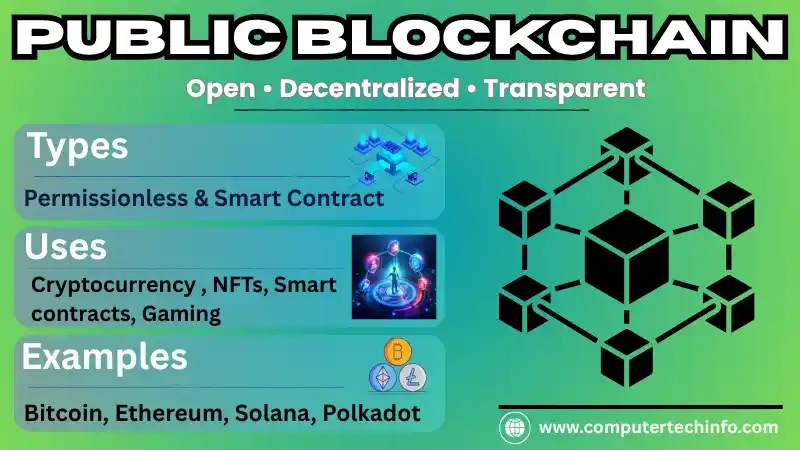
Let us discuss a public blockchain is a distributed ledger open to everyone, where anyone can view, verify and contribute to the network without permission from a central body. This level of openness is what makes it different allowing a transparent and decentralized environment.
Characteristics of Public Blockchain
There are many characteristics of public blockchain architecture that separate it from different from other types of blockchains. Let’s discuss them:
Also Read: Types of Blockchain Network Technology and its Examples and Use Cases
- Every node has access to read and write on the ledger
- Anyone can download and add nodes to the system
- The technology is fully decentralized in nature
- It offers anonymity, which means no one can track your transactions back to you
- It’s a bit slower compared to the private blockchain
Types of Public Blockchain
There are different kind of public blockchain, like as:
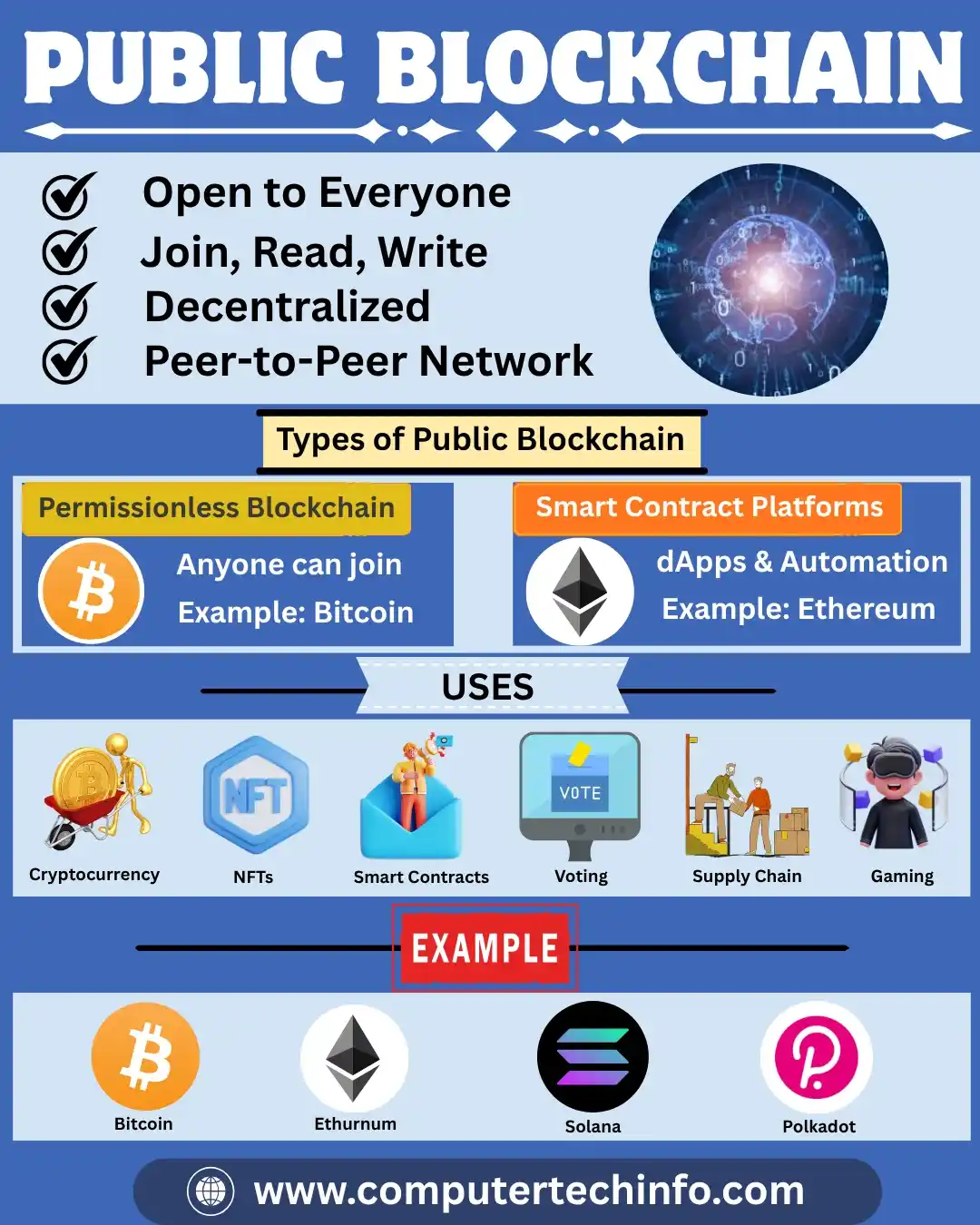
Permission-less Blockchain
- Anyone can join and participate
- No central authority
- Fully distributed
Examples: Bitcoin & Ethereum
Proof of Work (PoW) Blockchain
- Uses mining to validate transactions
- Requires high computational power
- Very secure but energy-intensive
Examples: Bitcoin
Proof of Stake (PoS) Blockchain
- Validators are chosen that based on stake (coins held)
- More energy-efficient than PoW
- Faster transaction processing
Examples: Ethereum & Cardano
Delegated Proof of Stake (DPoS) Blockchain
- Users vote like validators (delegates)
- Faster and scalable
- Slightly less decentralized
Examples: EOS & TRON
Hybrid Public Blockchain
- Combines features of public and private blockchains
- Some data is open, but other restricted
Example: IBM blockchain solutions
Advantages of a Public Blockchain
Public Blockchain Diagram
Accessibility: If we talk about accessibility that means public blockchains always open to anyone along with an internet connection. It allowing people from all over the world to join and use the network. This allows everyone to participate and benefit from the system.
Innovation: As we know the public blockchains support creation by giving developers a platform to create new applications and services that use the network. This has resulted in many decentralized applications, adding digital identity systems and supply chain management tools.
Security:Let’s talk about public blockchains use advanced cryptographic algorithms to secure and verify transactions and run on a decentralized network. These factors make them highly secure and resistant to attacks as any attempt to alter or manipulate the data on the network would be detected by the other nodes.
If we are talking about the security of a blockchain increases as more participants join. It is knownthat a larger number of nodes verifying transactions. It becomes much harder for a single malicious actor to take control. To compromise the network, they would need to control most of the nodes which is extremely difficult.
Transparency: As we know the anyone can view and verify the transactions that happen on the network. This creates a high degree of trust and accountability since all of the parties involved in the network can see the same information.
Disadvantages of Private Blockchains
Security risks: It is known that private blockchains are more security than traditional databases but are more vulnerable than public blockchains due to having fewer nodes. A hacker gaining access could handle the data or halt transactions.
Also Read: What is Soft Computing? Applications and Techniques
Lack of transparency: Lets us discuss a privacy is a priority in private blockchains. The meaning the data is not openly visible. It making it more difficult to validate its accuracy.
Cost: As we know the private blockchains can be expensive to set up and maintain because it needs a certain amount of computing power and data storage. As a result, the costs will go up as the amount of data grows. In contrast with public blockchains the costs are distributed to everyone running a node and the rewards cover the costs.
Centralization: In private blockchains a single organization often controls the network. which goes against the fundamental idea of decentralization in blockchain technology.
Public Blockchains Use Cases
Cryptocurrency Transactions: As we know the main use of public blockchains like Bitcoin and Ethereum. And this technology allows peer-to-peer transfers of digital currencies without getting to need for intermediaries.
Non-Fungible Tokens (NFTs):Next, we talk about NFTs that represent ownership of different kinds of digital items. Such as art or collectibles on public blockchains. It is knowing the Ethereum is the main platform where NFTs are created (minted) and traded.
Supply Chain Management: It is knownthat by using public blockchains supply chains become more transparent and traceable. It allowing stakeholders to confirm the source and journey of products. As we know VeChain is an example of a company applying this technology.
Voting Systems: As you know public blockchains can support secure and transparent voting systems. It helping to reduce fraud and make trust in election results. Its many projects are focused on implementing digital voting using this technology.
Identity Verification: It is knowing the public blockchains can give decentralized identity solutions. It allowing users to manage and verify their identities without relying on centralized authorities; for examples areuPort and Civic.
FAQs (Frequently Asked Questions)
Final Remarks
In conclusion public blockchains are a transformative technology. Its core features of decentralization, transparency and security. It can revolutionize multiple industries.
Also Read: Android Version List A to Z With Name
Its evolution is expected to drive innovations in decentralized finance, digital identity and tokenized assets. It promoting inclusivity in the digital economy.