
The story of computers is really interesting. They started as huge machines that must fill an entire room. Over time, they are going to smaller, faster, and easy to use. The second generation of computer was an important step in this journey. These computers were better than the first ones. They worked faster, better, and must do more things.
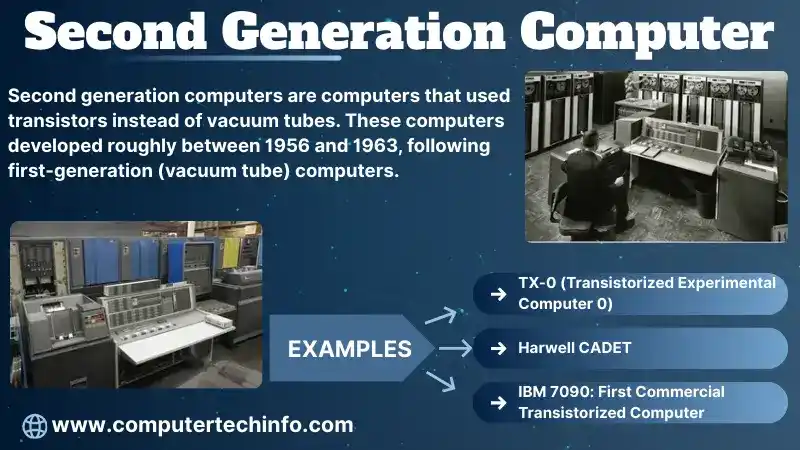
Here we are explaining the second generation computers in easy language. You will learn around their main features, benefits, and disadvantage.
It also shows that how they were different from first generation computers. Find how transistors and magnetic cores generated computers in the 1950s and 1960s.
2nd Generation of Computer History
We are explaining the Second generation computers, also called transistor computers. They are developed in 1956 to 1963. They came about a decade after the first generation computers. It solved many problems that the earlier machines had. But, they quickly replaced the first-generation computers.
Also Read: Third Generation of Computer and its Examples, Features, Characteristics, & Uses
These computers developed in the 1950s using the latest technology of that time. They used transistors first of vacuum tubes. So, they built faster, smaller, and more reliable. A well structured than the first-generation computers.
Technology Used in the Second Generation Computer
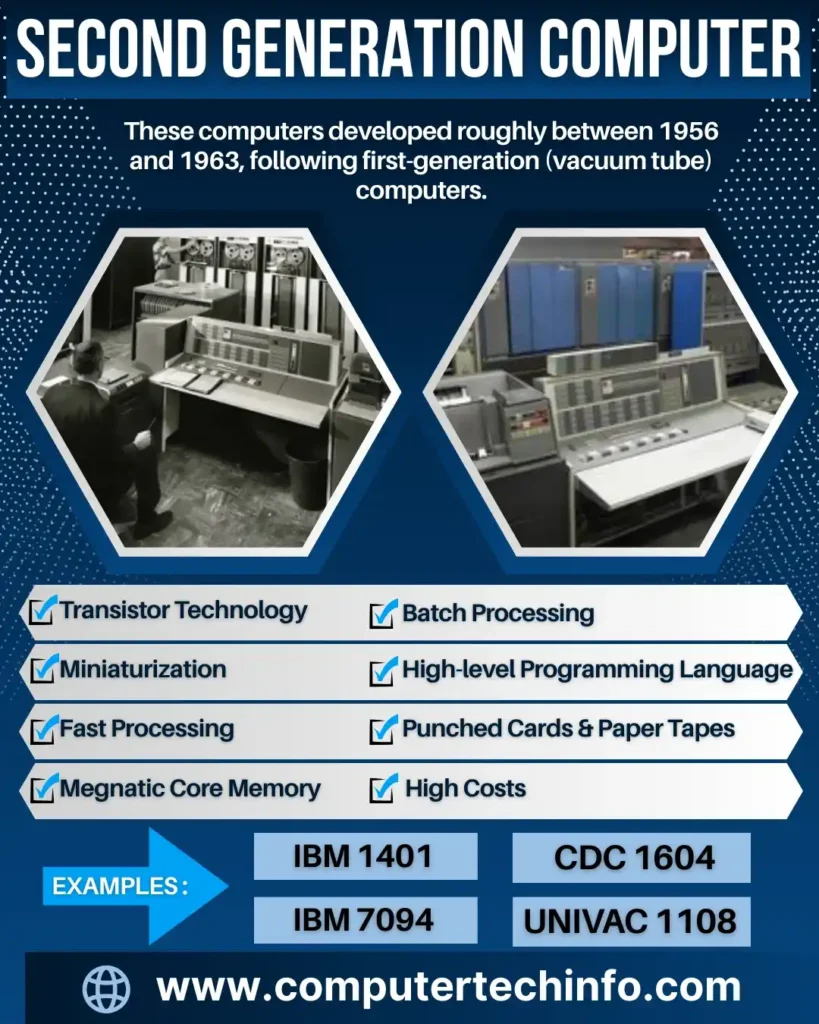
- Second-generation computers used transistors first of vacuum tubes.
- This programmed with assembly language and high-level languages like COBOL and FORTRAN.
- They worked on batch processing systems, it allowing the better performance and multiprogramming.
- Magnetic cores were using as main memory, such as magnetic tapes and disks.
- Punch cards were still used like input.
- Printouts on paper tapes continued as the main output method.
Second Generation of Computer Examples
Here are 10 most popular 2nd generation of computer examples:
1) IBM 1401
Here, we discuss the IBM 1401 is one of the most popular second generation computers. It introduced around 1959 and quickly in offices and business companies.
The IBM 1401 helped businesses move from manual accounting to automatic computer based systems. That type of computer use for office work faster and more accurate.
Key Features:
- It uses transistors first of vacuum tubes, that builds the computer smaller, faster, and better.
- It has magnetic core memory, which stores data safely and allows quicker access.
- It works on batch processing. Here, many tasks are collected and processed together.
- It helps programming languages like COBOL and FORTRAN, making it helpful like both business work and scientific calculations.
2) IBM 7090
Let us disuses the IBM 7090 was a powerful scientific and engineering computer. It was an improved transistor based version of the earlier IBM 709 and was launched in 1959. This computer was much faster and a big improvement in computing speeds.
Also Read: Fourth Generation of Computer and its Examples, Features, Benefits, & Technology
We discuss the IBM 7090 was mostly using in space research, nuclear science, and engineering calculations. NASA used in fast space missions like the Mercury and Gemini projects.
Key Features:
- Fully transistor based design, making it faster and more reliable.
- High processing speed like complex scientific calculations.
- Uses magnetic tape are storing data.
- Helps FORTRAN, and very high level programming language mainly used in science and mathematics.
3) UNIVAC 1108
Now, let us discuss the UNIVAC 1108 that established in 1964. It made by the Sperry Rand Corporation. Even if it was released a little later, they are still based on transistor technology of the second generation. It also showed early features of third-generation computers.
This computer improved multitasking and system sharing. It acted as a bridge between second and third generations. It’s helping move computers from single user machines to shared computing systems.
Key Features:
- Uses 36-bit architecture to handle large amounts of data.
- Has magnetic core memory like main storage.
- Helps time sharing, allowing many users to work at the same time.
- Compatible with FORTRAN and COBOL, creating programming easier and more efficient.
4) IBM 1620
The IBM 1620 was also called CADET that means Computer with Automatic Decimal Electronic Technique. It introduced in 1959 mainly like education and research purposes.
Also Read: Fifth Generation of Computers and its Examples, Features, and Benefits
This computer was widely using in universities and technical institutes. It helped students get their first hands on experience with computers is one of the most popular teaching machines of that time.
Key Features:
- Affordable and transistor-based, suitable such as colleges and research labs.
- Helps symbolic processing such as mathematical and logical calculations.
- Compatible with FORTRAN, helping students learn real-world programming concepts.
5) CDC 1604
Here, we are going to discuss about CDC 1604 that developed by the Control Data Corporation in 1959. This is one of the first fully transistor based computers that commercially successful.
This computer was mainly using for military and scientific work. It played an important role in weather forecasting, defense research, and large data calculations.
Key Features:
- Faster processing speed compared to earlier computers.
- Uses magnetic core memory and punch cards for data input.
- Can handle large and complex numerical data easily.
- Supports assembly language and FORTRAN for programming.
6) UNIVAC LARC (Larger Automatic Computer).
Next, the UNIVAC LARC introduced around 1960 like scientific research and advanced engineering work. It was one of the first computers to use parallel processing. That means it must be perform many calculations at the same time.
Also Read: Hybrid Computer: Examples, Types, Advantages, & Disadvantages
The U.S. Navy used this computer for nuclear simulations and complex scientific research.v This is one of the most powerful computers of its time.
Key Features:
- Fully transistor based design
- Supports parallel processing for faster calculations
- Built for high-speed scientific and data analysis work
- Supports early programming systems for engineering tasks
7) IBM 7094
The IBM 7094 launched in 1962 as an upgraded version of the IBM 7090. It provided higher speed and better data handling for technical and scientific applications.
This was widely using in NASA labs, engineering firms, and universities. It helped in aerospace research and early space mission calculations.
Key Features:
- Uses floating-point arithmetic for accurate scientific results
- Supports FORTRAN IV, an improved programming language
- Larger memory and faster processing than earlier models
8) Honeywell 800
The Honeywell 800 was introduced in 1960 mainly like business use. Large companies used it for accounting, payroll, and data processing work.
This computer helped automate office tasks and reduced manual work and time.
Key Features:
- Fully transistor-based system with stable performance
- Uses magnetic drum and tape for storage
- Efficiently handles large business records
- Supports COBOL, ideal for business applications
9) Philco Transac S-2000
Let disuses the about Philco Transac S-2000 was developed in 1958. It was one of the first commercial computers to use surface barrier transistors, which were faster and more reliable.
It was mainly using in laboratories and defense systems for high-speed data processing. Its design influenced future high-performance computers.
Key Features:
- Advanced transistor technology for higher speed
- Faster operation compared to many similar computers
- Suitable for scientific, research, and defense work
- Supports FORTRAN and assembly language
10) IBM 1130
Let we are going to explore the IBM 1130 that developed in 1965. It acted as a bridge between second and third-generation computers. Even if it came later, it still used transistor based Solid Logic Technology (SLT) first of integrated circuits.
Also Read: 17 Different Types of Computer and Their Functions | Examples of Computer
This system made computers affordable like small businesses and educational institutes, helping more people adopt computer technology.
Key Features:
- Compact, low-cost, and transistor-based system
- Uses disk storage instead of punch cards
- Employs SLT modules connecting old and new technologies
- Supports FORTRAN and assembly language
Characteristics of Second Generation Computers
The second generation of computers had few cool features that made them way better than the first ones.
Smaller Size
Because of transistors, second generation computers were much smaller than earlier ones. They were no longer limited to big laboratories and must be using in offices, colleges, and research centers.
Low Power and Heat
These computers consumed less electricity and produced very little heat. This helped them run smoothly like long hours without frequent breakdowns.
Faster Processing
They worked much faster and must be solve calculations quickly, just like a very powerful calculator.
Easy Programming
Programming languages became simpler and closer to normal human language. This made computers easier to learn and use.
More Memory
Improved memory allowed these computers to store much more data, making them better like business and scientific work.
What Are Advantages And Disadvantages Of Second Generation Computer?
In this portion, out team will spread light on the many benefits and drawbacks of using 2nd generation computer, like as:
Advantages of Second-Generation Computers
Few important benefits of second generation computers over first-generation computers are:
Smaller Size: These computers were much smaller because transistors replaced large vacuum tubes.
More Reliable: Transistors were stronger and did not fail easily. So, the computers worked more smoothly.
Energy Efficient: They used less electricity and produced less heat, that are cooling systems were still needed.
Faster Speed: Data processing became much quicker, saving time and increasing efficiency.
Better Accuracy: Calculations were more accurate with fewer errors.
Easy to Move: Due to smaller size, these computers were simple to install and use in different places.
Disadvantages of Second-Generation Computers
Even though second generation computers were better than the first generation, they still had some problems:
Cooling System Needed: They produced less heat, but cooling systems were still needs to avoid overheating.
High Maintenance: Daily checking and maintenance were necessary to keep them working properly.
Costly Machines: Manufacturing these computers was expensive. So, only big organizations could afford them.
Limited Use: They were mainly used like scientific work and business data processing, not like general use.
Punch Card Input: Data was entered using punch cards. That was slow and inconvenient compared to today’s devices.
FAQs (Frequently Asked Questions)
Who Invented The Second Generation Of Computer?
Here, we will explain the second-generation computers that were not invented by one single person. It’s developed by many scientists and engineers in 1950s.
What Is The Second Generation Of Computer Called?
As told above; the second generation of computers is called the transistor generation because they used transistors in place of vacuum tubes.
What Are Second Generation Computer Storage Devices?
Second generation computers used magnetic tape, magnetic drums, and magnetic disks to store data and programs.
Bottom Lines
At the final words, second generation of computers was a big step forward in technology. They brought progress, better performance, and many improvements over earlier computers.
Also Read: Block Diagram of Computer with its Components and Functions
These computers laid the foundation like future generations and helped shape the modern computers we use today. It’s important to price these early machines as the stepping stones that made today’s technology possible.


