
Let us discuss about an if you had to share internet between devices without Wi-Fi? This is a Wireless Ad Hoc Network ( WANET) comes in useful .
A Wireless Ad Hoc Network is sets up automatically, Works without router or tower where devices connect directly each other without using routers, base station and centralized control.
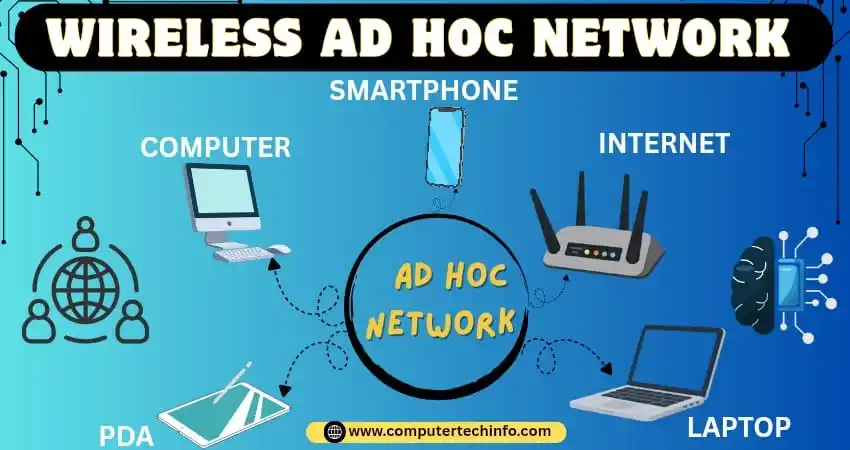
WANET has become very popular over the years due to its flexibility and ease of use. It is very easy to use and going to use in places where there is no network. We will learn here about the disadvantages and advantages along with how it can be actually using in real life.
What is Wireless Ad Hoc Network (WANET)?
A wireless ad hoc network is a type of local area network that can be creating instantly so that two or more wireless networks can be directly connecting. These devices can connect and share data with each other without the need for network infrastructure. It does not require any equipment such as a wireless router or access point.
In most cases, a wireless Ad Hoc network can be creating using the Wi-Fi interface of a PC, laptop, or Smartphone. Otherwise, devices such as wireless sensors are specifically designed for Ad Hoc mode.
Because devices in an Ad Hoc network can easily access each other’s servers directly, whether through basic peer-to-peer (P2P) or point-to-multipoint, there’s no need for a central server for specialized file sharing or printing. In a WANET, a group of devices, or nodes, such as wireless-capable PCs or smart phones, handles network operations such as routing, security, and key management.
When Should You Use An Ad Hoc Wireless Network?
Whether to use Ad Hoc mode or Infrastructure mode depends entirely on the usage requirement. For example, users who want the WAP to act as a permanent access point with an on-site or cloud based Wireless Local Area Network (WLAN) controller should choose Infrastructure mode. However, if a user wants to set up a temporary wireless network between a small number of devices, Ad Hoc mode would be a good choice.
A great example of this is where a Smartphone connected to cellular internet and its Wi-Fi is set to Ad Hoc mode. This can be using so that a Wi-Fi-enabled laptop can connect to that Wi-Fi Ad Hoc network and access the internet via the Smartphone’s cellular internet link. This eliminates any need for WAP or WLAN controller.
As everyone knows it doesn’t take much time to set up and starts working immediately, making it suitable for use during disasters, military situations, and travel. This network can be set up fastly due to the presence of dynamic and adaptive routing protocols.
These networks are created quickly and on the fly, allowing for a compact and cost-effective, fully wireless local area network without the need for any wireless infrastructure equipment. They are also effective in providing temporary access to the Internet if the wireless access point or router goes down.
Types of Ad Hoc Wireless Networks?
Ad hoc wireless networks can be further divided into MANET, VANET, SPAN, WMN.
There Are Four Types Of Ad Hoc Wireless Networks:
MANET
A mobile ad hoc network (MANET) is an independent system of mobile nodes connected by a wireless network. This type of network is self-setup and centralized, making it easy to deploy in difficult situations where conventional infrastructure is unavailable or difficult to deploy. MANETs are characterized by their dynamic topology, as nodes move, join, and leave the network, and links can be frequently lost.
VANET
As we know a vehicular Ad hoc network is a type of network. Which is designed like vehicles to communicate with each other to facilitate road safety and traffic? It’s used in smart cities, linked vehicles and autonomous driving systems.
The main purpose of VENTs is to make sure safe travel by providing drivers and passengers with timely warnings and traffic related information.
SPAN
Now we are talking these are Smartphone’s connected to each other. SPANs allow users to share data without needing a mobile network and WI-FI. Its allowing them to stay connected in areas with limited access.
The main purpose of these network is used for communication and entertainment.
WMN
As we know wireless mesh network (WMN) is an ad hoc communication system. Its uses mesh network to connect wireless nodes. It’s creating a network with multiple communications.
Such a network is particularly suitable for applications. Where secure and stable communication is need under complex conditions. Like industrial control, surveillance systems, and emergency services.
Wireless Ad Hoc Network Examples & Uses
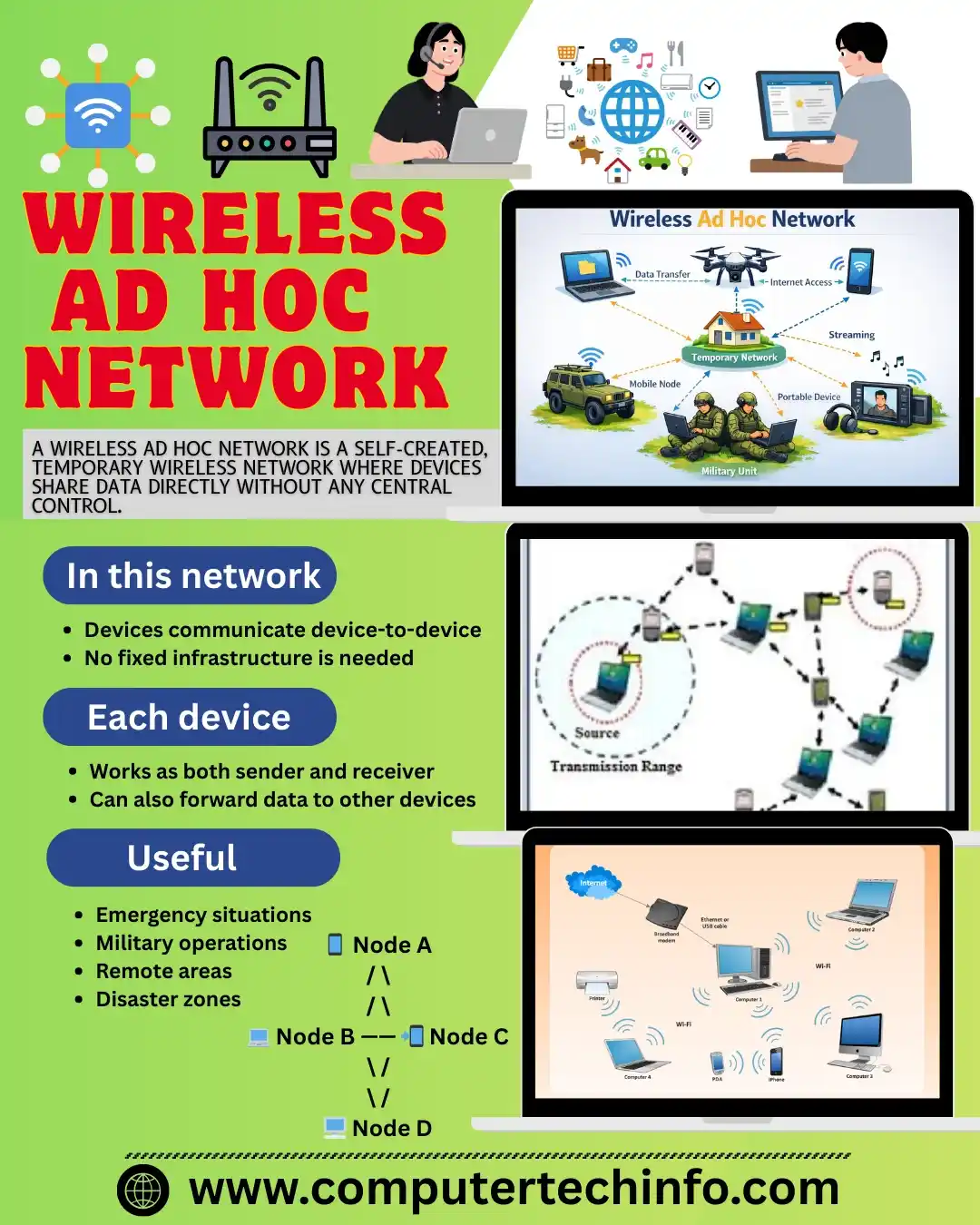
Here are few examples of Mobile Ad Hoc Network.
Mobile Ad Hoc Network (MANET)
A self setup wireless network established by mobile devices.
Example Uses:
- Military battlefield communication
- Disaster recovery operations
- Temporary meetings or conferences
The devices linked directly without a central router.
Vehicular Ad Hoc Network (VANET)
A special type of MANET used between vehicles.
Example Uses:
- Car-to-car communication
- Traffic warning systems
- Accident alerts
Vehicles communicate directly to share speed, traffic, or hazard information.
Wireless Sensor Network (WSN)
Includes of many small sensor nodes that collect and transmit data.
Example Uses:
- Environmental monitoring (temperature, humidity)
- Forest fire detection
- Smart agriculture
Sensors meet with each other without fixed infrastructure.
Bluetooth Ad Hoc Network (Piconet)
A small, short-range ad hoc network using Bluetooth.
Example Uses:
- Phone connected to wireless earbuds
- Laptop connected to wireless mouse
- File sharing between Smartphone’s
No router required.
Smartphone Hotspot / Peer-to-Peer Sharing
A mobile transfer its data with other devices.
Example Uses:
- Internet sharing in remote areas
- Temporary group connectivity
Mesh Networks
Devices act as both hosts and routers, send data like others.
Example Uses:
- Community Wi-Fi networks
- Smart home systems
Each node helps extend network coverage.
Real-World Situations Where Ad Hoc Networks Are Used
- Earthquake or flood rescue operations
- Military missions
- Outdoor festivals
- Remote village communication
Wireless Ad Hoc Network Advantages And Disadvantages
Advantages Of Wireless Ad Hoc Networks
No Fixed Infrastructure Required
- No need for base stations or centralized routers.
- Useful in remote areas or disaster situations.
Easy and Quick Deployment
- Networks can be set up rapidly.
- Ideal like military operations, emergency rescue, and temporary events.
Cost-Effective
- No need for expensive infrastructure.
- Lower installation and maintenance costs.
Flexible and Dynamic
- Nodes can join or leave the network anytime.
- Supports mobility of devices.
Scalable (to an extent)
- There are too many so nodes can increase.
Supports Peer-to-Peer Communication
- Direct communication between devices less dependency on centralized control.
Disadvantages of Wireless Ad Hoc Networks
Limited Bandwidth
- Wireless medium has lower bandwidth compared to wired networks.
Battery Constraints
- Nodes rely on battery power.
- Energy consumption can be high due to routing and forwarding tasks.
Security Vulnerabilities
- Here are sensitive to attacks, like eavesdropping, spoofing, and DoS.
- No centralized monitoring system.
Routing Complexity
- Frequent topology changes make routing difficult.
- Special routing protocols (such as AODV, DSR) are need.
Limited Range
- Communication range depends on device power.
- Multi-hop communication increases delay.
Scalability Issues
- Having more nodes causes a decline in performance.
Unstable Connections
- High mobility may cause frequent link failures.
FAQs (Frequently Asked Questions)
Does An Ad Hoc Network Need a Router?
It does not require a central router or access point for its operation.
What Is A MANET?
This is a network in which mobile devices flexibly connect.
Is an Ad Hoc Network Secure?
This network operates without a centralized security system. Its making it more susceptible to attacks.
Is It Suitable for Large Networks?
The performance may be affected as the number of nodes increases.
Final Thoughts
In conclusion ad hoc network have a great choice for any situation. Where traditional structure is unavailable or impractical. They are easy to set up. They do not need additional hardware for users.
On the other hand, they can be slower and less secure than other network. Its can be a good solution for users. Who looks to connect many devices in a costly and useful way fastest.


