All generation computers play important role of the hardware, features, ability, and improve performance. Each generation has new different role in the computer predecessors. The different core technology is using each generation. So, we know uses technique a different computer efficient for previous computer.

Did you know, first generation of computer was used vacuum tubes? A second generation was used leveraged transistors. A third generation was using integrated circuits. Fourth generation computer was utilize the VLSI circuits.
A present fifth generation of computer used in AI (artificial intelligence) and ULSI. Time to time change the technique. So, we computer are work is easily.
We discuss in these articles about Fourth generation of computer. This computer totally depends on Large Scale Integrated (VLSI) circuits.
What is the Fourth Generation of Computer?
Did you know, a fourth generation of computer establish in 1971 and 1980. In this computer are using the Very Large Scale Integrated (VLSI) circuits technology. It has name the microprocessors.
Small circuits get replacing by VLSI technology. So the central processing unit came on one chip.
Fourth generation computers are very small, fast, and cheap that increased the use of PCs. They also had GUI, making computers easy to use.
These computers help networks and multitasking and used easy languages like C and C++
Fourth Generation Computer History in Brief
The fourth generation of computers started around 1971 to 1981. It started with the creation of the microprocessor.
Also Read: Fifth Generation of Computers: Examples, Features, and Benefits
Because of the microprocessor, computers changed small and affordable. So, they must be using at homes, offices, and businesses.
During this time, many games and helpful programs were developed. Software transformed is very important; so this generation has name the software generation.
Fourth Generation Computers Architecture
Fourth-generation computers were building of five main units that worked together smoothly. Each unit had its own job but supported the others. These units were the input unit, arithmetic and logic unit (ALU), memory unit, control unit, and output unit.
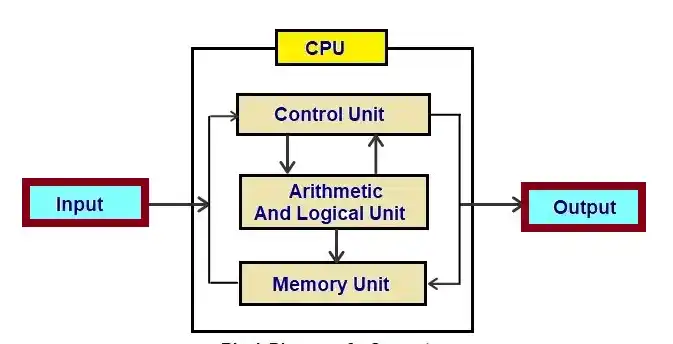
The input unit takes data or instructions from the user. Like typing on a keyboard, this input gets processing by working with other parts of the computer. The control unit manages and controls all activities that making sure instructions are following correctly.
The arithmetic and logic unit (ALU) does all the calculations and logical work. The memory unit stores important data and results. In output unit shows the final result of the work, like on a screen or as a printout.
Fourth Generation of Computers Used Technology: Based On
Very Large Scale Integrated circuits (VLSI) or microprocessors were used as the central processing unit of the computers.
Keyboards, mouse, and microphones were using for input.
The architecture included input, output, arithmetic and logic, memory, and control units.
The concept of the Internet introduced and the development of networking between systems began.
Used many high level languages like COBOL, FORTRAN, and C
Personal computers and microcomputers were revolutionized.
Outputs were given on screen, paper, and other forms.
Better storage devices were used.
Fourth Generation of Computer Examples
Here are few common examples of fourth generation computers:
- Micral
Micral was a series of early microcomputers that start with the Micral N in 1973. It was the first computer sold commercially that used a microprocessor. So, it is many time called the first personal computer.
Micral N used the Intel 8008 microprocessor. It had a special board system and must connect many parts together. Programs were entered using punched tapes. Input/output was done between a teleprinter or modem.
After Micral N, newer models released like Micral G, Micral S, and later Micral M, Micral CZ, Micral C, Micral V Portable, and R2E Micral CCMC.
2) IBM 5100
Did you know, IBM 5100 mobile computer they established in 1975. It used a special processor called PALM and 64 KB of RAM. They built in ROM memory.
This computer was called “portable,” but it was very heavy, weighing about 55 pounds. A magazine described it as a 50-pound personal computer. Further, it reaches in keyboard, small CRT screen, processor, tape drive, 100 KB ROM, and 64 KB RAM.
3) Altair 8800
The Altair 8800, established in 1974. It was a famous fourth generation computer. It used the Intel 8080 processor. They are 8 bit CPU running at 2 MHz, with very limited memory.
This computer had no keyboard, screen, or printer. Users gave input using switches, and the output was shown between blinking lights.
4) STAR 1000
STAR 1000 developed by Control Data Corporation (CDC) in 1974. It was the first computer sold commercially in its category that was a vector supercomputer with 64-bit architecture.
It helps parallel processing, which build it very fast. STAR stands like Strings and Arrays. These computer present new ideas that helped improve future computer technology.
5) PDP 11
PDP 11 created by Digital Equipment Corporation (DEC) in 1970s. It was a series of 16 bit minicomputers. It was very popular.
These computers were small and affordable, so more people must be use. They were programmed using the C language. This is the one of the easiest high level programming languages.
6) CRAY – 1
CRAY-1 was a supercomputer build by Cray Research and delivered in 1976. They are very popular, cause of it fastest speed. It used vector processing, which helped it do complex calculations quickly, especially for science and engineering. The computer was famous like its C-shaped design and liquid cooling system.
Uses of Fourth Generation Computers
Personal Computing: A Personal computers (PCs) like IBM PC, and Apple Macintosh. Microsoft computers create it possible like people to use computers at home, school, and small businesses. They created computers closer to everyday life for everyone.
Also Read: What is Motherboard? Components, Functions and Types
Business and Office Work: Fourth generation computers used a lot in businesses and offices. They helped with typing documents, control accounts, storing data, and using spreadsheets for work.
Education: With the growth of personal computers, schools and colleges started using them for teaching, research, and office work. Computers became an important tool in education.
Banking and Financial Applications: In this generation, computers were using in banks for ATMs. A online banking, managing accounts, and processing financial data. They made banking faster and easier for both banks and customers.
Gaming: With better graphics and faster processing. Fourth-generation computers create video games possible in arcades and on personal computers.
Scientific Research: Computers helped scientists with complex calculations, data analysis, and copy.
Telecommunications: They improved data transmission, signal processing, and network management, creation communication faster and more reliable.
Software Development: Stronger computers and more storage and build it easy advanced software. This involves the operating systems, business programs, and games.
Features of Fourth Generations of Computes
Advanced microprocessors changed the computer industry and made computers much faster.

Also Read: What is Difference Between CPU and GPU? GPU Vs CPU
Better storage allowed computers to save large amounts of data and information.
Input and output devices like keyboards and mouse improved performance and ease of use.
Computers of this generation were much faster are easy generations.
They used less power and electricity.
They produced less heat, so air conditioners didn’t require.
These computers were more reliable and easy to use.
Advanced software and systems build computers simpler to handle.
They used high-level programming languages like C++, KLI, RPG, and SQL.
These computers were flexible and must be moving easily from one place to another.
Fourth Generations of Computer Characteristics
The fourth generation of computers have other name the Personal Computers (PCs).
They do not need an air conditioner for cooling.
Having the better internal and external storage for saving data.
They come with a GUI (Graphical User Interface), making them easy to use.
They need an operating system like smooth performance.
Use advanced technology like VLSI (Very Large Scale Integration).
These computers designed as commercial products for daily users.
Make connection to other computers between networks.
Using printers and scanners made them more helpful for everyday tasks.
What are Advantages and Disadvantages of 4th Generation Computer?
Now, let discuss the advantage and disadvantage of fourth generation of computer.
Advantages of Fourth Generation Computer
- Computers are smaller because of the microprocessor.
- The microprocessor builds computers faster, more reliable, and able to do complex tasks.
- This generation saw the start of computer networking and the Internet.
- Computers were cheaper than earlier generations.
- They produced very little heat, so air conditioners were not needed.
- The processing power of these computers was very good.
- They did not need high maintenance.
- Input and output devices like keyboards and mice were easy to use.
- They must run high-level languages like C and C++.
- Fourth-generation computers were good like personal and business use.
Disadvantages of Fourth Generation Computer
- Sometimes air conditioners needed because of the use of ICs (Integrated Circuits).
- Designing and making microprocessors was very complex.
- Advanced technology needed to make VLSI circuits.
- Even these computers produced little heat. They still needed fans to cool the inside parts.
- During heavy use, the fans made annoying noises.
- Since these computers are still using integrated circuits. Advanced technology needed to make them.
FAQs (Frequently Asked Questions)
Who Invented The Fourth Generation Of Computer?
The fourth generation of computers is microprocessor. It developed by Ted Hoff, Stanley Mazor, and Federico Faggin.
What Are Examples Of Fourth-Generation Computers?
Here is example: IBM PC, Apple II, and fast personal computers.
What Was The Major Impact?
Introduction of personal computers like home and office use.
Which Programming Languages Were Used?
A programming used C, C++, BASIC, and old versions to Pascal.
Conclusion
The fourth generation of computers opened many new possibilities. It made computers popular for general use, and the idea of personal computers like daily use became common.
Also Read: Hybrid Computer: Examples, Types, Advantages, & Disadvantages
This generation saw big improvements in computers, but there was still room for further advancement. This led to the development of the fifth generation of computers.