If you want to understand the different types of blockchain, this article covers them all and helps you pick the most suitable option for your project.
There is no doubt that blockchain has evolved a lot in the last decade. It started with bitcoin, which offered public blockchain the first type of blockchain. We can also term bitcoin’s blockchain as the first generation of blockchain technology.

Today, we have many kinds of blockchain technology. Each one is useful for solving particular problems. Many companies are adopting them to make the most out of their advantages.
What Are Different Types Of Blockchain Technology?
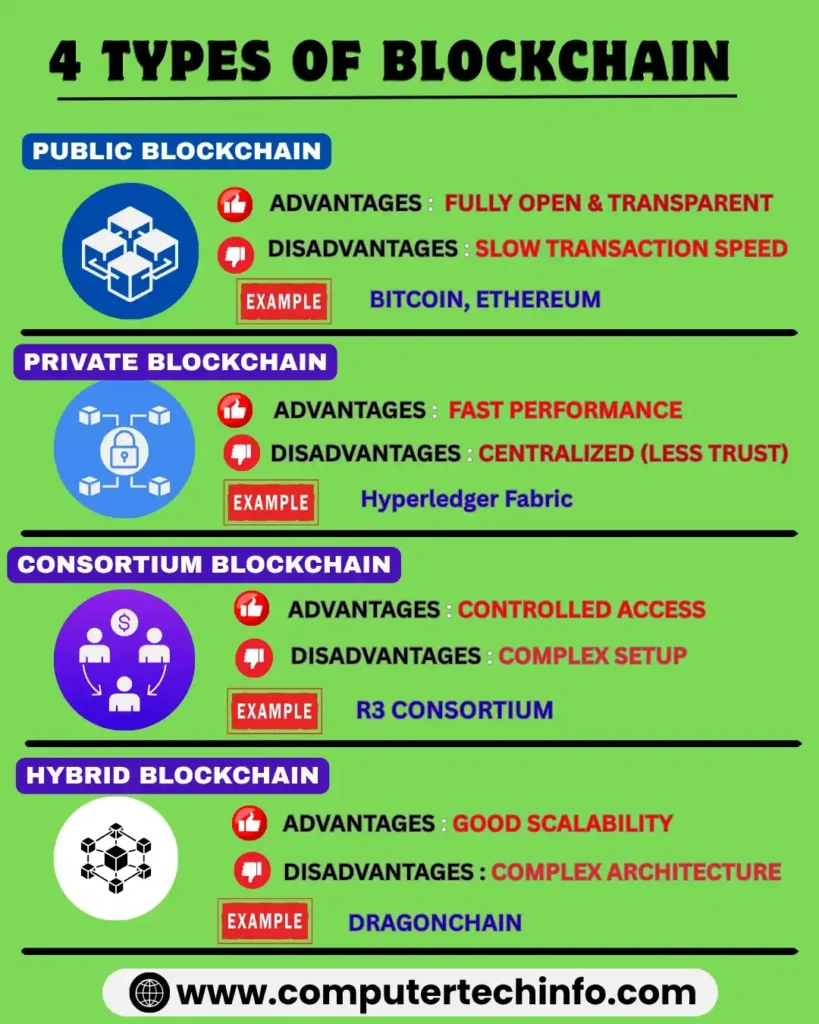
There are different types of blockchain networks based on who can access, use, and validate the data. The four main types of blockchain networks are:
Public Blockchains
As we know public blockchains fall under the category of public and distributed allowing everyone in the network to participate. It is knowing all blockchain nodes in the public blockchain network hold equal access to the blockchain. It creates new data blocks and confirms the data on the blocks.
Also Read: Android Operating System and its Features, Advantages and Disadvantages
These blockchains are mainly using to mine and exchange cryptocurrencies like Bitcoin, Litecoin and Ethereum. Nodes solve complex problems to make new blocks and validate transactions.
Those who mine earn small Bitcoin rewards for their efforts. Like bank tellers, miners process transactions and receive payment.
Advantages
a) It gives robust security, full transparency, and permanent records, since multiple nodes verify the blockchain and prevent changes.
b) Highly innovative and diverse, because anyone can make and use applications on the network.
c) It open and accessible to all, allowing anyone to participate without restrictions or costs.
Disadvantages
a) There is a low processing capacity and efficiency, because it can process only a limited number of transactions while using significant resources.
b) As we know that not very private, since the public ledger allows anyone to view user data and transactions.
c) It is known that highly volatile and unpredictable, because the network is affected by market changes and outside factors.
Examples of Public Blockchain: Bitcoin, Ethereum, Litecoin, NEO
Use Cases
There are many applications for public blockchains. Let’s list some of them.
Voting: It using public blockchains, governments can carry out voting in a secure and transparent way.
Fundraising: It is know the companies or programs can make use of the public blockchain for improving transparency and trust.
Private (Managed) Blockchain
Lets define the private blockchains depend on restricted access and permissioned relationships. It new users are usually invited and approved according to the platform’s rules.
Also Read: Windows Operating System and its Features, Advantages and Disadvantages
These blockchains are using for internal corporate transactions, and only company members or employees usually have access. Non-members may be granting access, if need. R3 Corda and Hyperledger Fabric are notable examples.
Advantages
a) It highly adjustable and efficient because the network can handle many transactions per second while using less energy.
b) It high privacy and confidentiality because only authorized users can see transactions and data of the users.
c) It highly stable and reliable, because the network is less affected by market changes or outside factors.
Disadvantages
a) As we know the low security, transparency, and stability, because only a few nodes verify the ledger, and it can be changing by the authority or middleman.
b) It is know the low level of creation and variety. As the network is restricted and limited by the rules and regulations of the authority or the coordinator.
c) As we understand low inclusion and availability, because the network is restricted and need permission or fees to join.
Examples of Private Blockchain: Multichain, Hyperledger Fabric, Hyperledger Sawtooth, Corda
Use Cases
Supply chain management: It organizations can implement a private blockchain to manage their supply chain.
Asset ownership: It assets can be tracking and verified using a private blockchain.
Internal Voting: The private blockchain is also effective at internal voting.
Federated/ Consortium Blockchains
Let us discuss about the Federated blockchains also called partnership blockchains are a hybrid solution that combines features of public and private blockchains.
Also Read: What is Operating System and its Types? Uses & Examples
It is know that some organizational data is visible, while other information remains private in a partnership blockchain.
In a partnership blockchain selected nodes handle agreement. The network is not fully public but remains distributed and run by many organizations.
Advantages
a) It balanced scalability and efficiency, because the network can handle a fair number of transactions per second and uses a balanced amount of energy.
b) It moderate privacy and confidentiality. because the ledger is semi-private and only authorized users can view transactions and data.
c) It average stability. because the network experiences some changes from the market and external factors.
Disadvantages
a) It moderate security, transparency and stability because the ledger checked by a limited number of nodes and can be changing by authorized authorities.
b) It moderate innovation and diversity. Because, the network is partly limited by the rules of the authorities or intermediaries.
c) It moderate level of inclusion and accessibility. As the network is partially exclusive and need permission and fees to join and participate.
Examples of Consortium Blockchain: Marco Polo, Energy Web Foundation, IBM Food Trust.
Use Cases
Banking and payments: A group of banks can form a partnership and choose which nodes will validate transactions.
Research: A partnership blockchain can help share research data and findings.
Food tracking: It is also useful for tracking food.
Hybrid Blockchains
As we know hybrid blockchains may look like collaboration. But they are different though they share some sameness.
It is know the hybrid blockchains combine the advantages of both private and public blockchains. They are ideal for those who want the benefits of both without choosing just one.
Advantages
a) It adjustable scalability and performance. As the network changes the number of transactions and energy use depending on demand.
b) It flexible privacy and confidentiality. because the ledger can be public or private depending on the type of transaction or data.
c) It flexible stability and stability. because the network can manage market changes and external factors using its internal rules.
Disadvantages
a) It complex security and transparency. As the ledger is checked by a variable number of nodes and can be changing depending on who has authority.
Also Read: Android Version List A to Z With Name
b) It complex level of creation and variety. As the network is getting to inspire by different factors and forces depending on the participation and the validation.
c) It complex level of inclusiveness and accessibility. As the network is determined by different criteria and conditions depending on the join and the involvement.
Example of Hybrid Blockchain: Dragonchain, XinFin’s Hybrid blockchain
Use Cases
Real Estate: Hybrid networks can be using in real estate; where companies run their systems privately while sharing some information publicly.
Retail: As we know retail businesses can use hybrid networks to make their processes more efficient.
Highly regulated markets: It is knowing the hybrid blockchains are also good for highly regulated markets such as financial markets.
Final Remarks
In final blockchain has develop far beyond its early crypto starting. It is know today there are different types of blockchains, each offering different features and applications.
Also Read: Unix OS with its Examples, Types, & Functions
As we know private blockchains offer control and security for businesses. Public blockchains give openness and decentralization used in crypto and decentralized apps. It hybrid blockchains gives the best of both worlds with customizable networks.
These blockchains help groups of companies share information and trust each other. By knowing about these improvements, you can see how blockchain helps systems work better and more safely.