Let us discuss the An IP address serves as a logical identifier for a device at the network layer enabling communication across different networks. In contrast, a MAC address is a physical identifier using at the data link layer for communication within a local area network. Before data is delivered locally, the IP address is mapped to a MAC address.
The Address Resolution Protocol is using in local area networks to find the MAC address of a device when its IP address is already known. It works at the data link layer of the OSI model.
This topic is main for roles like network administrators, cybersecurity experts, system administrators, IT technicians and entry testers.
What is Address Resolution Protocol (ARP)?
As we know Within a local area network the Address Resolution Protocol allows devices to identify the permanent MAC address corresponding to a given IP address. The MAC address is the physical identifier assigning to the device’s network interface.
The Address Resolution Protocol helps the conversion between 32-bit IPv4 addresses and 48-bit MAC addresses. As both use different address lengths.
Also Read: Reverse Address Resolution Protocol and its Complete Guide
It is understand the Address Resolution Protocol operates between Layer 2 and Layer 3 of the OSI model. This connects MAC addresses at the data link layer with IP addresses at the network layer.
It is know that the Address Resolution Protocol can also be using with other LAN technologies like Token Ring, FDDI and ATM to support IP communication.
Address Resolution Protocol – History
As we know the Address Resolution Protocol introduced in 1982 by David C. Plummer through RFC 826. It developed to facilitate dynamic address resolution in Ethernet based networks.
Although ARP is still important in IPv4 networking, IPv6 uses the Neighbor Discovery Protocol instead. It evolving technologies ARP continues to be fundamental in local IPv4 network communication.
How Does Address Resolution Protocol (ARP) Work?
Let’s discuss the using ARP devices on a LAN can resolve an IP address to its corresponding MAC address. Below is a step by step example using Device A and Device B:
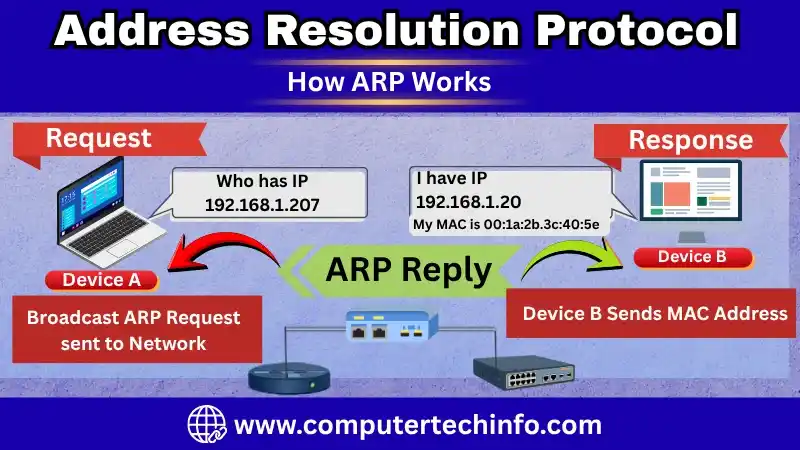
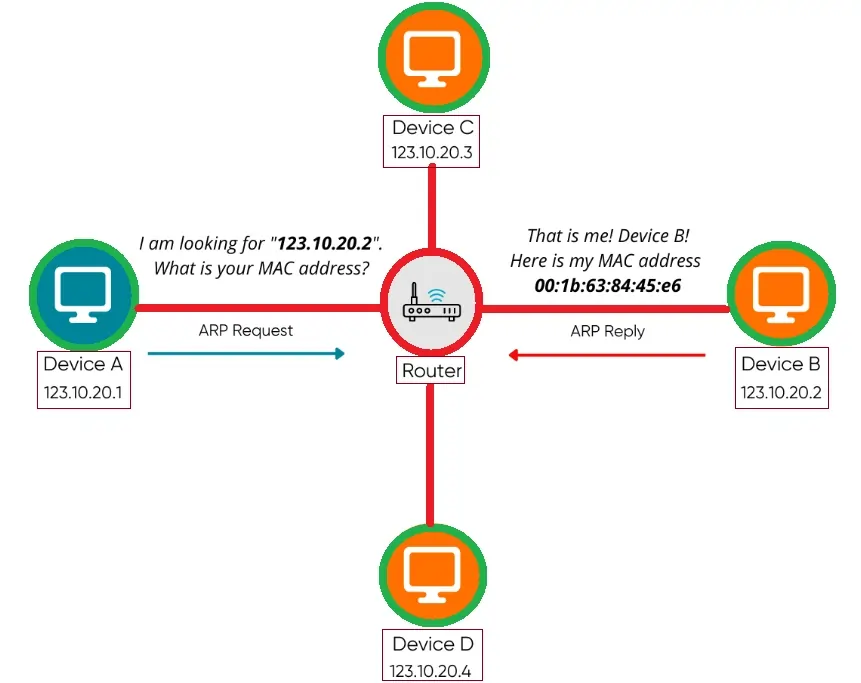
Let’s define Device A wants to talk to Device B, so it needs to find out Device B’s MAC address.
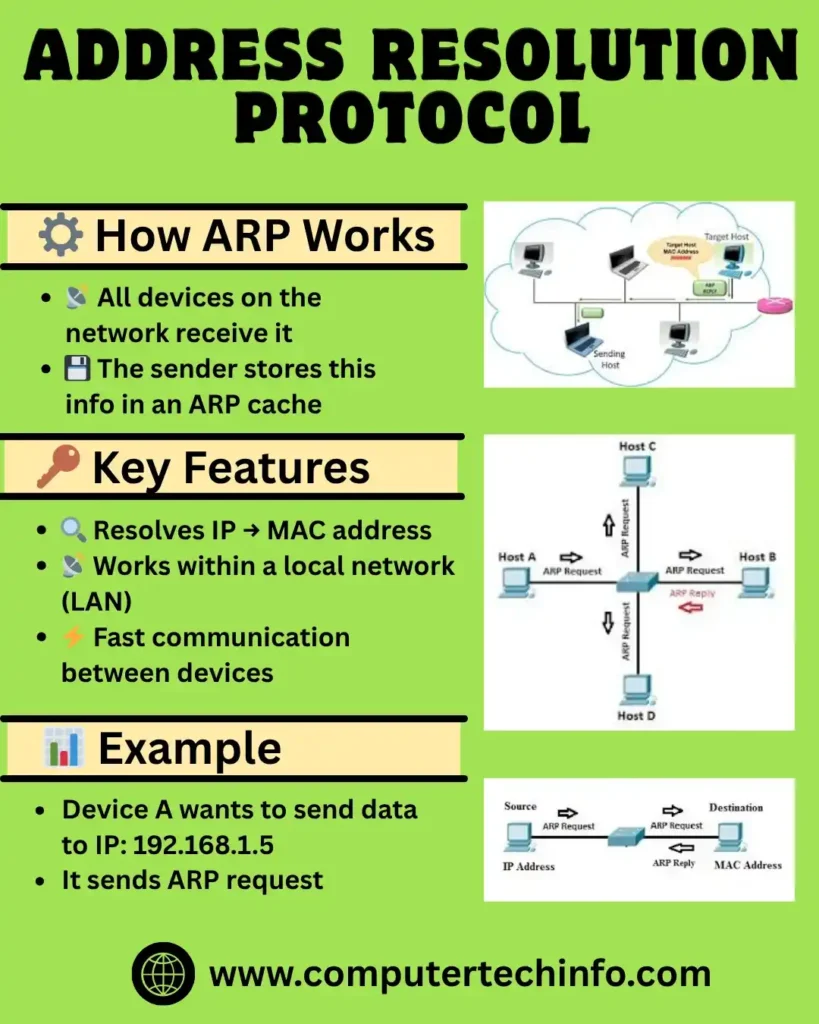
As we know Device A shouts out to all devices on the local network: Who has this IP address? Please tell me your MAC address! It’s trying to reach Device B.
It is knowing all the device on the network gets the ARP request, but only Device B has the matching IP address and sends a reply.
Device B sends an ARP reply packet. Itadds physical MAC address.
Device A receives the ARP reply. It has the MAC address of Device B.
It is known Device A and Device B now know each other’s MAC addresses. So, they can communicate directly using the physical addresses.
The ARP cache of Device A is updated with the new mapping.
Device A can now send data to Device B. It using the MAC address that discovered.
Also Read: Twisted Pair Cable and its Types, Examples, & Applications
Now we talking about ARP operates at the data link layer of the OSI model. It uses the broadcast mechanism to reach the target device. So, these broadcast protocol. Its also a stateless protocol meaning it doesn’t keep a table of the recently searched.
If Device B gets a new IP address Device A must send another ARP request to find the MAC address for the new IP.
Address Resolution Protocol Table Works with Examples
As we know the device needs to send data. Its check the ARP table first. If no match it broadcasts an ARP request. The owner replies with its MAC populating the table. The entries age out to manage changes like moves.
Viewing the Table
Use platform-specific commands:
| OS | Command | Example Output |
| Windows | arp -a | 192.168.1.1 00-0c-29-e7-0f-2e |
| Linux/macOS | arp -n or ip neigh | 192.168.1.2 00:0c:29:63:af:d0 |
| Cisco IOS | show arp | 192.168.1.10 0011.2233.4455 |
Key Fields
- IP Address: Protocol address (e.g., 192.168.1.50).
- MAC Address: Hardware address (e.g., aa:bb:cc:dd:ee:ff).
- Type: Dynamic (learned) or Static (manual).
- Interface: Network adapter bound to entry.
Common Uses Examples
- Troubleshooting connectivity (e.g., duplicates signal ARP conflicts).
- Security audits (check for poisoning attacks where attackers spoof replies).
- Network mapping—tools like Wireshark capture ARP traffic.
It is known that create a static ARP entry that stays after a reboot using arp -s 192.168.1.10 aa-bb-cc-dd-ee-ff on Windows. It use arp -d. In IPv6 networks ARP is replacing by Neighbor Discovery.
Gratuitous ARP
As we know gratuitous ARP is when a device sends out a broadcast on the network to let other devices know its IP and MAC address. It has two main purposes:
Also Read: Hardware Components of Computer Network
It updating the ARP caches of other devices to prevent outdated entries.
Checking for duplicate IP addresses on the network.
Let’s define the device announces its IP to the network with Gratuitous ARP: if nobody replies it’s safe to use. If someone replies the IP already taken which can lead to problems.
Let’s talk the using Gratuitous ARP devices make sure no one else is using their IP. It helping the network stay stable and conflict free.
ARP Use Cases & Applications
As well-known ARP importance gives simple communication. Here how it impacts daily networking tasks.
Device Communication: It is known a device every time sends packets within a LAN, ARP confirm. These packets reach the planned receiver.
Troubleshooting Tools: Let’s define the using ARP -a administrators can check which IP addresses get mapping to which MAC addresses. It helping fix network issues. Tools like Wireshark allow them to watch ARP traffic in real time.
Address Allocation: As we know when DHCP gives a device a new IP address. It uses ARP to make sure no other device is already using that same address.
ARP Benefits and Drawbacks in Networking
There are many advantages and disadvantages of using address resolution protocol, including:
Benefits of Address Resolution Protocol
Enables seamless device communication: As we understand ARP gives smooth communication within a local network by converting IP addresses into corresponding MAC addresses. This address resolution approach allows devices to exchange data without delays or additional doubts.
Also Read: Peer to Peer Network Architecture and its Types and Examples
Boosts network performance: It maintains a cache of IP to MAC address mappings. It reducing the frequency of broadcast requests. This targeted communication decreases network blockage and improves alertness and efficiency.
Strengthens network security: It monitoring ARP traffic helps administrators detect unusual or unauthorized behavior such as duplicate responses to the same IP request. which typically reflects spoofing. This visibility helps teams respond to evolving security threats proactively.
Offers configuration flexibility: It supports automatic IP to MAC address mapping and removes the need for manual input. when new devices are added. This approach simplifies network maintenance and supports scalability.
Simplifies troubleshooting and diagnostics: As we know the administrators can easily access and inspect the ARP cache to verify, if devices are mapped correctly. This streamlines network troubleshooting by identifying and resolving communication failures.
Challenges of Address Resolution Protocol
Vulnerable to ARP spoofing attacks: It is prone to attacks like ARP spoofing. because it functions at a low level without built in authentication. It is malicious actors can copy valid devices to stop or alter data traffic.
Also Read: What is Hub in Network? Types and Its Working
Generates excessive broadcast traffic: As we know ARP depends on broadcast messages to resolve MAC addresses. This can overload the network in large environments. It leading to unnecessary network blockage and reduced performance.
Lacks authentication mechanisms: One of ARP’s core limitations is its absence of verification features. This makes it challenging to authenticate device identities and shows the network to spoofing and man in the middle attacks.
Limited built in security controls: It offers minimal security features. This reflects that it cannot detect or safe malicious behavior. It posing a risk to the overall network integrity.
Vulnerability to unauthorized access: ARP is shows the security vulnerabilities without proper device validation. This allows unauthorized or untrusted devices to respond to genuine requests and gain unauthorized access to sensitive network communications.
FAQs (Frequently Asked Questions)
Bottom Lines
At the final, the Address Resolution Protocol is main for local network communication as it translates IP addresses into their corresponding physical MAC addresses.
Also Read: What is Wireless Ad Hoc Network? Types, Examples, Uses, and Pros/Cons
It functioning at the data link layer it relies on broadcast messages to locate the target device.
Hence a solid grasp of ARP is important for network administrators and learners in networking.
If this article is valuable for you, then please share it along with your friends, family members, pet lovers or relatives over social media platforms like as Facebook, Instagram, Linked In, Twitter, and more.
Do you have any experience, tips, tricks, or query regarding on this? You can drop a comment!
Have a Nice Day!