A Wide Area Network(WAN) is a type of computer network which connects in a big and multiple offices WANs are using to connect the large geographically areas. The main advantage of the WAN is this is helpful with the secure connectivity throughout the country or beyond. So, now you will get to know all types of WAN network with their examples.
There are multiple WANs which are using like different purposes. The term we called as topologies. Here are the main 3 topologies are define the WAN connection Point to Point, Multipoint, and Mesh.
Each and every defines the difference and comes with the special needs. In this page you will go between with all the WANs types this helps you to choose the best fit for you.
Different Types of WAN Technology with Examples
Businesses are select different types of WAN solutions depend on their goals, budget, and network needs; make it easy to connect locations skillfully and securely.
Also Read: 10 Examples of WAN Network in Real World – Full Guide
Let’s explain the different types of WANs in detail.
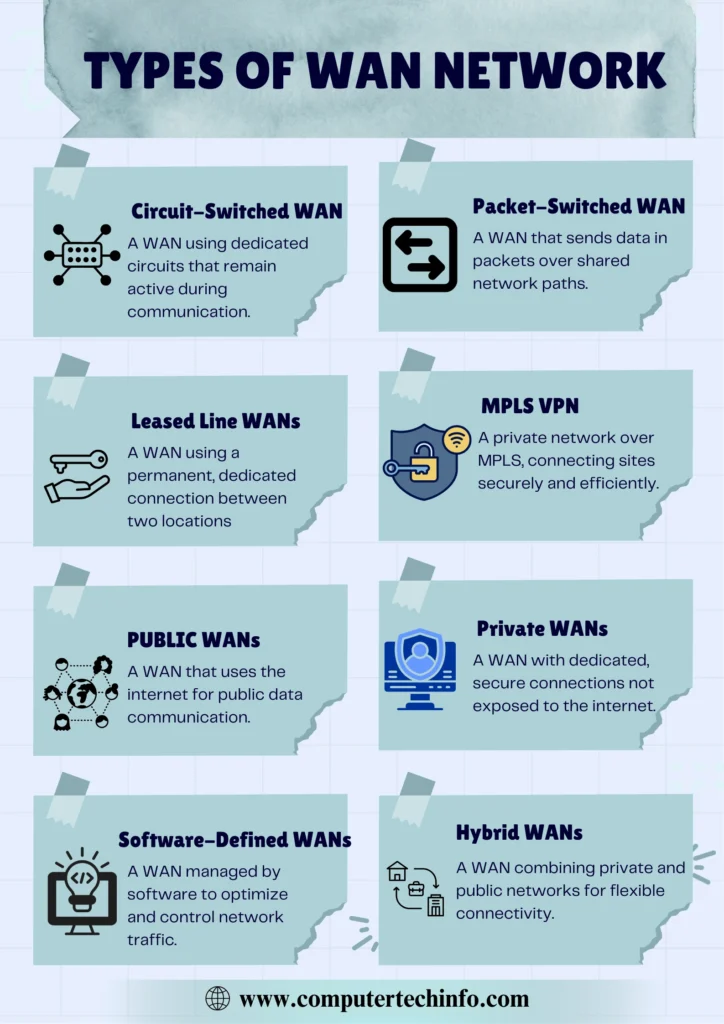
Circuit-Switched WAN
As you know, Circuit switched WANs use a fixed, dedicated link same to old telephone lines are active all over the board, but fixed and good performance.
But, simple provide systems is need to small, a link is point to point connection, and people device replace.
Packet-Switched WAN
In the second type of WAN we talk around the Packet switched WANs in help to split the data into few packets and send the data to the other shared network. We are explaining the advantage it is cost helpful and flexible. If we are talking around the topologies in comes under the multiport.
Both MPLS and Frame Relay go to packet switched WANs. MPLS is most used today, it manage traffic but low delay, and good like real time applications. As Frame Relay is now outdated is replaced by modern solutions such as MPLS and SD-WAN.
Leased Line WANs
Leased line WANs provide an eternal, always on link between two locations, offer offices, data centers, and remote sites to stay fixed and good link.
Few Use Cases
- Enterprise communication
- Interconnection of data centers
- Access to high speed internet
MPLS VPN
MPLS VPN is a private network service that runs over a service provider MPLS network to deliver secure Layer 2 or Layer 3 link. It links join remote sites using flexible setups like site to site, multipoint, or mesh networks. Customer data stays different and private between MPLS labeling, not encryption, give the infrastructure.
Also Read: Advantages and Disadvantages of WAN | Pros & Cons
MPLS stands in between other VPN services but it allows businesses order different types of traffic. Creating better application performance in flexible QoS levels. With speeds reach alike 10 Mbps to 10 Gbps and costs close to dedicated internet connections. MPLS grew the industry quality like private networking thanks to its good, performance, flexibility, and competitive pricing.
PUBLIC WANs (Internet-Based WANs)
Unlike private WANs, public WANs most rely on the internet like data exchange and are widely using by businesses and single like communication, cloud services, and remote access.
Examples of Public WANs:
VPNs are a few examples, creating a secure virtual network that saves sensitive data and using a public link.
SD-WAN uses software to intelligently control and improve data traffic over internet based WAN connections.
Private WANs
This is not like the public WAN that built and used like one particular single organization. These WANs are basically using and offer great control.
Examples:
- Virtual SD LAN like MPLS
- Leased Private Lines
- Private VPNs
Benefits for Private WANs
Private WANs offer very high security since data does not travel over the public internet.
As you know, they deliver stable performance with consistent data flow and very low latency.
Networks are customized to match an organization’s specific business goals.
Challenges of Private WANs
Setting up and maintaining a private WAN is costly due to hardware and infrastructure needs.
Also Read: What is Difference Between Switch and Hub? Switch Vs Hub
Compared to public WANs, private choice offer less flexibility and variety.
These networks are best suited like big enterprises or government organizations that need maximum security and strict control.
Software-Defined WANs
SD-WAN is a Digital and present path to connect businesses with software to control connections. SD-WAN are make sure network decisions in real time it automatically stop traffic around traffic or outages in seconds. Many times ago users even notice all move wrong.
How SD-WAN Works?
It employs few internet connections, like broadband, LTE, and MPLS.
Traffic get routing dynamically depending on performance metrics.
Oversees security, reliability, and costs
Worldwide security Effective costs and reliability
Key Benefits of SD-WAN
- This is also helpful in low costs rather than MPLS networks
- Real-time traffic management improves performance
- Inbuilt encryption enhances security
SD-WAN provide a combination of cost savings and high performance, thus transform the WAN technology.
Wireless WAN
We are explaining different types WAN is mostly range are Long distance and wide range is help of Radio signals.
Also Read: Difference Between Router and Switch in Networking! Router Vs Switch
Examples of Wireless WANs:
- Likewise Mobility and corporate connects via 5G and Wireless Wi-Fi
- Satellite WANs to communicate the lines where on ground network is not available
Advantages
- Removes the need like physical cables
- Ideal like businesses on the go since it provides mobility
- Use in rural and remote areas comes with expanded coverage
Limitations
- Interference from signals impacts performance
- Satellite networks usually come with a higher latency
- Big scale use comes with expensive costs and data caps
Wireless WANs is play an important role like worldwide mobile users are their better connectivity and communication. This is also helpful like emergency networks.
Hybrid WANs
Hybrid WANs are the important role in the business. Its helps combine 2 or more area networks into one. This approach is highly recommending by businesses to good performance and cost.
Common Hybrid WAN Configurations:
- MPLS + Internet (Broadband or LTE)
- Leased Line + SD-WAN
Benefits of Hybrid WANs
- Cost savings, uses cheaper internet alongside MPLS
- Improved redundancy make sure network uptime
- High scalability, easy to add new sites
This is affect by the bigger enterprises also its increasing day by day in big enterprises but is cost success and flexibility.
Satellite WANs
Satellite WANs are the most important type of WANs among all. This WAN allow for remote and to obtain internet access allowing for worldwide connectivity.
How Satellite WANs Work?
Data is forwarding through space using geostationary or low-Earth orbit satellites.
This network helps satellites to quick forward the data to ground stations and receivers.
Types of WAN Protocols
WANs use different protocols to manage data transfer and link network devices skillfully.
Also Read: Advantages and Disadvantages of Bridge in Networking | Features of Bridge
Asynchronous Transfer Mode (ATM) is old switching technology that sends data in small. A fixed size cells using time many division.
Frame Relay transfer data in frames around WANs and, while mostly outdated, are still offer low cost connectivity like budget focused networks.
Packet over SONET/SDH (PoS) is one of the best ever protocols which helps data packets be transmitted over point-to-point links that use fiber optics connections and SONET or SDH.
When you hear a word like MPLS this is the protocol that basically provides the path to a network from start to the end user. This is based on the predefined labels. If we talk about leverage then this can leverage the Ethernet and IP for efficient and effective data routing.
Carrier Ethernet expand standard Ethernet over the LAN into the WAN, allowing businesses to link their local networks directly to a service provider. It correctly links multiple LANs together, creating them function like a single, unified network.
Internet protocols (IP) basically helps to route data packets across the networks which are interconnected by using the IP addresses and helps to identify the sources and destination.
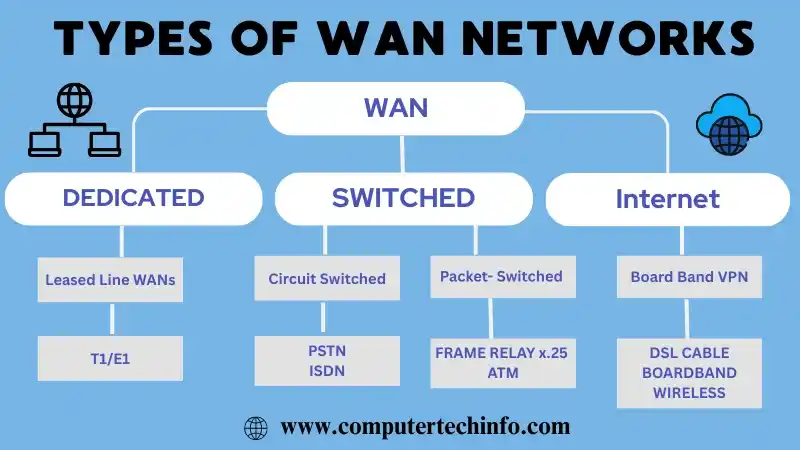
Types of WAN (Wide Area Network) Connections
Many businesses run their business using WANs to connect their operational activities. This helps to clear communication and connectivity. This is divided into 2 categories, explained below.
Switched WAN – This is the type of network which is basically a shared network based provided by the service provider. These connections are basically fixed only by the need to be shared.
Point-to-point WAN – This type of WAN is basically meant to link two different locations with a single communication line. This is not like shared networks. These WANs are used for stability and high speed.
A point to point WAN is just like private highways between two offices, No Traffic No sharing.
Final Thoughts
In this article, we have been explained the different type of the WAN lines, circuit switched, packet switched, and wireless all plan to meet special business needs.
Also Read: Differences between Internet and Intranet | Internet Vs Intranet
Choosing the right WAN depends on part like cost, speed, reliability, and coverage.
Understanding these options helps organizations build efficient networks like smooth communication and data sharing around distant locations.