In simpler terms a private blockchain is a closed network where only selected users are allowed to take part. Access is controlled and only authorized participants can read data or confirm transactions. It is making suitable for internal operations.
This design offers greater security, improved privacy and better control, which makes private blockchains highly appealing for organizations aiming to optimize their processes while keeping sensitive information protected.
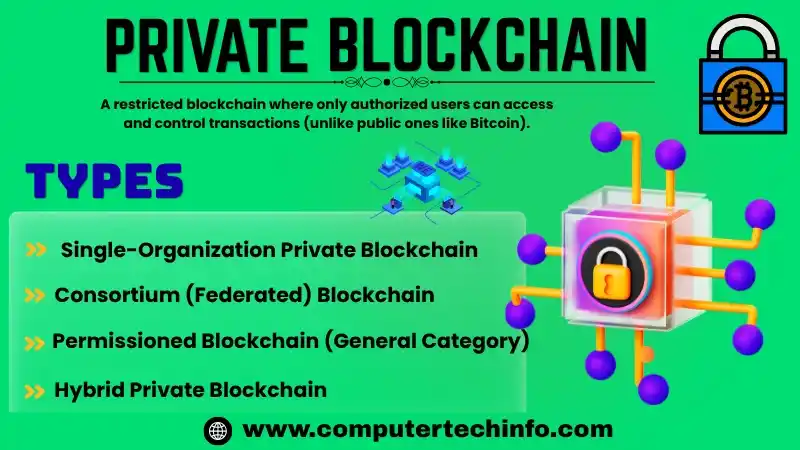
This article discusses private blockchain in depth.
What Is Private Blockchain?
Blockchain is a peer to peer distributed ledger system that securely records digital assets in a transparent and unchangeable manner.
It works without trusting on intermediaries, enabling direct interactions. This advanced technology is attracting interest because it helps minimize risks and safe fake activities.
As we know peer to peer networks such as blockchain considered superior to centralized ones. Because they deliver higher reliability, stronger privacy and better scalability without depending on a single vulnerable point.
Also Read: What is Public Blockchain? Types, Example, Use Cases, Pros & Cons
Blockchain achieves its distributed design by depending on collaborative communication and processing across multiple nodes.
Its P2P architecture has many benefits. As an example it is more secure than traditional client server networks.
Blockchains are going to protect against malicious actions. because their distributed peer to peer networks need approval from the majority of participants.
Why Use Private Blockchain?
Let’s define the blockchain technology highly advanced and has the potential to significantly transform the way the world operates. It could reshape traditional systems, including finance, by addressing many of their existing limitations.
As the potential of the system became clear, numerous global companies began paying close attention to it.
As we know major companies like Microsoft, IBM and Alibaba have actively supported and invested in this technology.
Private Blockchain Use Cases & Applications
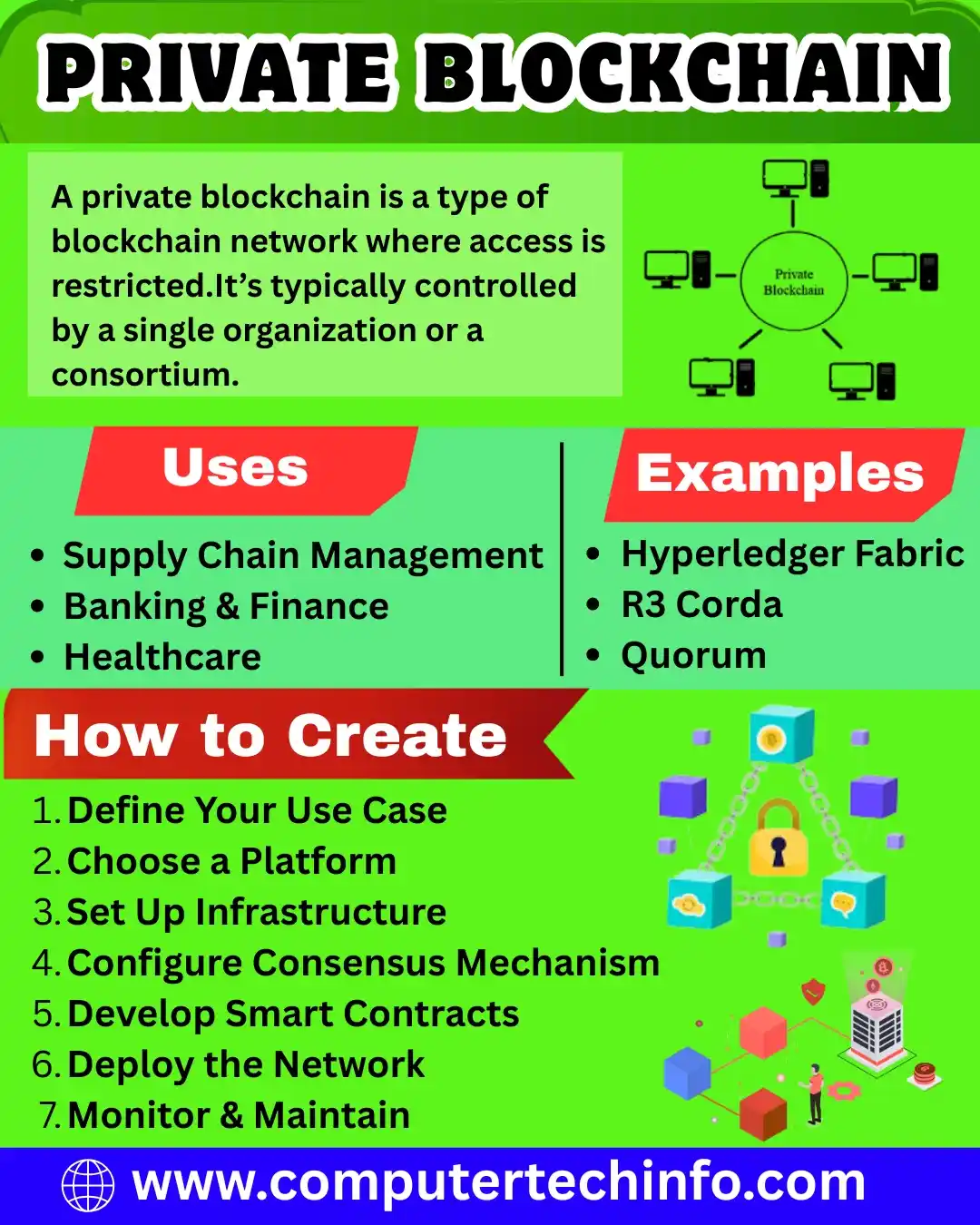
Insurance
It is known that blockchain systems gives a direct link between policyholders and insures. It reduces dependence on unreliable external systems and avoids the time consuming and costly nature of manual application management.
Banking & Finance
As we know financial transaction commonly involves multiple parties, each depending on its own internal systems. With blockchain banks can operate on a shared platform to track transactions more efficiently. It is making the process faster.
Healthcare
Let’s define blockchain is an effective solution for storing and managing electronic medical records that include patientshealth information. Blockchain based healthcare systems improve accessibility, strengthen data security and streamline medical reporting.
Supply Chain
In simple word blockchain technology enables companies to trace every component of a product, verify its authenticity and safe counterfeit goods from entering the supply chain. As a result, supply chains become faster, more transparent and more reliable.
Private Blockchains Examples
The most common private blockchain example that can be used in different projects and industries is the Hyperledger platform.
Also Read: Types of Blockchain Network Technology and its Examples and Use Cases
As an open-source project under the Linux Foundation, Hyperledger supports the creation of various business blockchain platforms like IBM Fabric, Intel Sawtooth, Iroha and Indy.
These components allow developers to design custom blockchain networks. Hyperledger supplies both a framework and compatible tools for further enhancement and adaptation.
Other popular examples of private blockchains are Corda, Ripple, Quorum, etc.
Difference Between Public and Private Blockchain
There has long been a comparison between the two types of blockchains. Let’s briefly look at how they differ.
In public blockchains anyone can contribute to the ledger and every transaction is openly shared across the entire network.
On the other hand, private blockchains allow participants to be clearly identified and the organization controls who has permission to write to the blockchain. As a result private blockchains ensure complete privacy by restricting access to authorized users only.
As we know another key difference is that public blockchains are fully decentralized. while private blockchains are only partially decentralized.
Public Vs Private Blockchain in A Tabular Form:
| Features | Public | Private |
| Accessibility | Anyone | Single Person/ Central Incharge |
| Who can join? | Anyone | Permissioned and known identities |
| Consensus Mechanism | PoS/PoW | Voting or multi-party consensus algorithm |
| Transaction Speed | Slow | Lighter & Faster |
| Decentralization | Completed Decentralized | Less Decentralized |
Want to gain an in-depth understanding of how Blockchain works andLighter & Faster how it can be implemented? Check out the best Blockchain certification courses now!
Private Blockchain Advantages and Disadvantages
There are many advantages and disadvantages of using private blockchain, including:
Advantages Are:
Empower Enterprises
Let’s talk a private network is designed to improve enterprises by supporting organizational needs rather than individual users. It prioritizes overall business benefits and is mainly used to improve internal systems within a company.
No Illegal Activity
It is access to the network is restricted through an authentication process. It is confirming the identity of all users and helping safe illicit activities.
More Scalable
As we know the limited number of participants in private blockchains reduces the size of the network. It is enabling easier deployment of changes and features and making the system more scalable.
Disadvantages Are:
Centralized
In simple word this type of blockchain is commonly used by enterprises and businesses. It is making more centralized.
Also Read: What is Soft Computing? Applications and Techniques
A single authority manages the system by authenticating and validating users.
Requires Trust
In private networks only selected trusted participants can verify transactions. As a result external users must depend on the system without having any control over validation.
Less Secure
As we know a private network typically has fewer validating nodes. which can make it more vulnerable to manipulation or control by malicious actors. This reduced distribution may increase the risk of security breaches and other threats. It is making less secure overall.
How to Create a Private Blockchain? Step-by-Step
Let’s discuss one by one about creating private blockchain:
1. 🎯 Define Your Use Case
Start with clarity:
Supply chain tracking
Internal financial transactions
Document verification
Identity management
Your use case determines architecture and features.
2. 🧱 Choose a Blockchain Platform
Pick a framework based on your needs:
Hyperledger Fabric – Section, approval, most used in enterprises
Quorum – Ethereum-based with privacy features
Corda – Designed for financial institutions
3. 🖥Set Up Infrastructure
You’ll need:
Nodes (servers running the blockchain)
Networking between nodes
Cloud or on-premise hosting (AWS, Azure, or local servers)
Each participant typically runs a node.
4. 👥 Configure Permissions & Identity
Private blockchains require strict access control:
Assign roles (admin, validator, user)
Use digital certificates for authentication
Define who can read/write/validate
5. 🔗 Select Consensus Mechanism
Unlike public chains, private blockchains use faster consensus methods:
PBFT (Practical Byzantine Fault Tolerance)
RAFT
Proof of Authority (PoA)
They function efficiently without involving any mining activities.
6. 🧾 Develop Smart Contracts
Smart contracts automate business logic:
Agreements
Transactions
Rules
For example, in supply chain, a contract can automatically update product status.
7. 🧪 Test the Network
Before going live:
Run simulations
Test transactions
Check security and performance
Top Private Blockchain Development Companies
These companies build custom private blockchain solutions for businesses:
Also Read: Android Version List A to Z With Name
Cubix – Enterprise blockchain & dApps development
Pharos Production Inc. – Hyperledger & private blockchain systems
Nadcab Labs – Ethereum & private blockchain development
SoluLab – Enterprise-grade blockchain solutions
Debut Infotech – Custom blockchain & consulting services
FAQs (Frequently Asked Questions)
End Note
In the end private blockchain are very important in technology as they offer robust, scalable and highly secure database services to many organizations. They give greater transparency in supply chains, helping to reduce waste and detect defects more effectively.
Also Read: Unix OS with its Examples, Types, & Functions
As we know private blockchain mainly operate within smaller network with some participants. They give easier management and lower downtime.
Lets define the compliance management is also made easier in a private blockchain environment. It is known the private blockchains help improve enterprise efficiency, success and scalability.
If this article is valuable for you, then please share it along with your friends, family members, pet lovers or relatives over social media platforms like as Facebook, Instagram, Linked In,Twitter, and more.
Do you have any experience, tips, tricks, or query regarding on this? You can drop a comment!
Have a Nice Day!