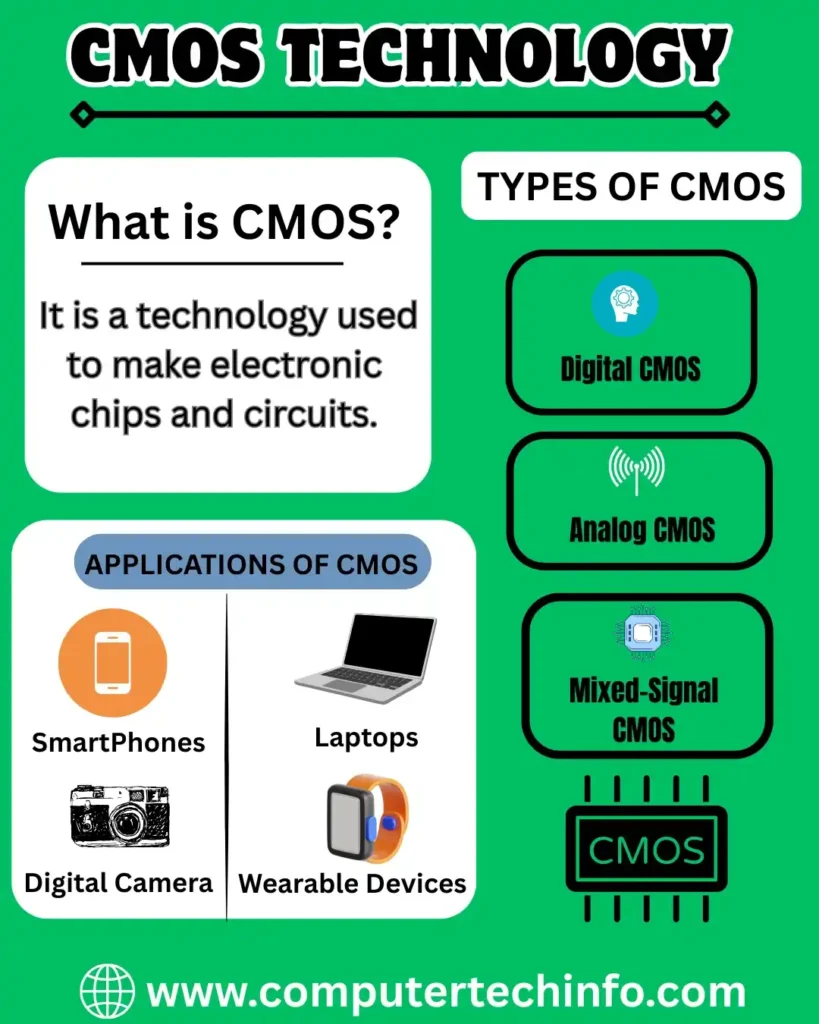
CMOS means “Complementary Metal Oxide Semiconductor”. It is a technology that used to make an electronic microchip in the microprocessors, microcontrollers, memory chips, and other electronic logic circuits. This technology works by using two types of the transistors like: NMOS (N-type Metal Oxide Semiconductor) other one is PMOS (P-type Metal Oxide Semiconductor).
The working of the CMOS transistor is a complementary way. This helps the circuit works efficiently. Structure of the CMOS consist two transistors one is PMOS connected to power supply and other is NMOS connected to ground.
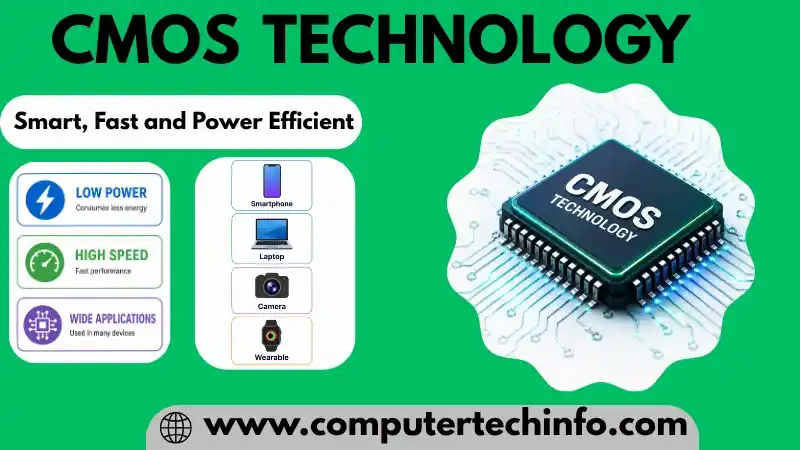
And they both transistors work together to create proper and correct result. And they use very less amount power to create output.
History of CMOS Technology
So let us take about the history part of the CMOS (Complementary Metal Oxide Semiconductor) technology:
Also Read: What is Digital Camcorder? Types of Camcorder with Functions
1960s: The CMOS (Complementary Metal-Oxide-Semiconductor) technology was first introduced with their conceptsin 1960s.
1963: Frank Wanlass, engineer at Fairchild Semiconductor Company. Introduced the idea of the CMOS technology.
1970s: So, in the 1970s, the researchers at RCA and IBM further created CMOS technology.
1972s: RCA organization introduced the first CMOS IC (Integrated Circuit).
1980s: After that CMOS become more famous. Because the CMOS use very less energy as compare to other devices. And useful for small electronic devices.
1990s: In this time CMOS technology become in very high demand choice for making semiconductor manufacturing. Because they use very less energy and devices work efficiently increase in the microprocessors.
2010s: CMOS technology rapidly growing, with that the production of smaller and more energy-efficient electronic devices will possible, like: Smartphone’s, tablets, and wearables.
Present: So, at present time the CMOS technology become a backbone of the modern electronic devices and in computer system.
Working Principal CMOS Circuit
So, let us discuss about the working of the CMOS circuit in brief:
MOSFET Basics
- The building element of the CMOS circuit in called MOSFET. There are mainly two types of transistors like: n-type (NMOS) and p-type (PMOS).
- The NMOS transistor create with of the n-type of the semiconductor material. And the PMOS created with of the p-type semiconductor material.
- The MOSFET have mainlyconsist three terminals: Gate (G), Source (S), and Drain (D).
Basic CMOS Inverter
- The CMOS have basic building block inverter, which consists both the NMOS and PMOS transistor connected in series other.
- When the input value is high (1). Then NMOS will turn on and joint the output directly to the ground.
- When the input value is low (1). Then PMOS will turn on and joint the output directly to the power supply (VDD).
Inverter Operation
- If the VIN is high NMOS turn ON and PMOS turn OFF. And the NMOS joints the output with the ground directly.
- If the VIN is low NMOS turn OFF and PMOS turn ON. And the PMOS joints the output with the power supply directly.
Inverter Operation
- VIN is high, the NMOS is turn ON, and providing low-resistance path to GND. The output is pulled low (logic 0).
- VIN is high, the PMOS is turn ON, and providing low-resistance path to VDD. The output is pulled high (logic 1).
So, the CMOS inverter is using to make the basis creation of more complex digital circuits, like: NAND gates, NOR gates, flip-flops, and other logical building blocks.
CMOS Logic Gates
CMOS (Complementary Metal-Oxide-Semiconductor) logic gates are the foundation of the building of electronic integrated circuits. So, there are some commonly using CMOS logic gates:
Also Read: What is Trackball and Their Function and Use?
CMOS Inverter
- The CMOS inverter is made by using the both NMOS and PMOS transistor connected in series.
- If the input is high (1), the NMOS turn ON (low impedance path to ground), pulling the output low.
- If the input is low (0), the PMOS turn ON (low impedance path to VDD), pulling the output high.
CMOS NAND Gate
- The CMOS NAND gate is made by joiningthe multiple transistors in series and parallel.
- It has two or more inputs (A, B …) and create the logical AND of those inputs.
Truth Table for Two-input NAND Gate
| A | B | Y |
| 0 | 0 | 1 |
| 0 | 1 | 1 |
| 1 | 0 | 1 |
| 1 | 1 | 0 |
CMOS NOR Gate
A CMOS NOR gate is made as similar as NAND gate, but with transistors arranged differently to create the logical NOR operation.
Truth Table for Two-input NOR Gate
| A | B | Y |
| 0 | 0 | 1 |
| 0 | 1 | 0 |
| 1 | 0 | 0 |
| 1 | 1 | 0 |
CMOS XOR and XNOR Gates
CMOS XOR (Unique OR) and XNOR (NOR) gates can be creating by using to join the inverters, NAND gates, and NOR gates.
How to Reset CMOS Battery?
To change settings of the CMOS (Complementary Metal-Oxide-Semiconductor) on your computer system, you can follow the steps:
Power Off: Firstly, shut down your computer system and turn off the energy supply.
Disconnect Power: Disconnect all the power supply of your computer system. Make ensure electrical current not flow in the system.
Open the Case: Then carefully open the system case of your system and access the motherboard.
Locate the CMOS Battery: Location of CMOS battery in computer system is motherboard; so it is called small coin-cell batteries that give power to the CMOS chip to retain settings.
Remove the CMOS Battery: Then carefully remove the CMOS battery from the socket with the help of any tool to remove the battery.
Wait for a Few Minutes: After the battery remove then wait few minutes to discharge the remaining power in the system. In this battery setting will reset.
Reinsert the CMOS Battery: Then put the CMOS battery back to the same spot properly.
Close the Case: then close system case properly.
Reconnect Power: After reinsert then connect the system with power supply.
Power On: Then turn ON the power. After start CMOS setting will reset with their default value.
How to CMOS and BIOS Work Together
The BIOS and CMOS both works together and manage the computer start-up system process. And the BIOS, stored in permanent memory on the motherboard, begin of the hardware components during boot.
Also Read: What is Computer Monitor? Types, Parts, Functions, Use, & Features
Then reads the configuration data stored in the CMOS memory, a temporary memory chip powered by a small battery, to access system settings such as date, time, and hardware parameters.
The CMOS stores the data and information even when the computer system powered off. The Coordination between BIOS and CMOS ensures proper hardware starting and system configuration, and give a smooth and consistent boot sequence for the computer system.
Difference Between CMOS and BIOS
| Feature | CMOS | BIOS |
| Nature | CMOS technology is a method use to make a semiconductor chip in the computer system. | BIOS is firmware, a set of rules stored in a chip, responsible for starting the hardware during the boot process |
| Location | Location found near the Southbridge | Location found in separate set of chips called EPROM or Flash memory in the motherboard of the system. |
| Functionality | Stores BIOS system settings | Starting the hardware during the booting process and gives runtime services for the operating system |
| Type | Is Hardware | Is Firmware |
| Upgradation | Can be upgrade through CMOS setup | Can be modify by Flashing |
CMOS Applications & Use Cases
CMOS (Complementary Metal-Oxide-Semiconductor) technology is very famous technology widely using in the electronic devices system. So let us discuss some applications of the CMOS
Digital Integrated Circuits
CMOS (Complementary Metal-Oxide-Semiconductor) mostly uses in to design electronic devices integral circuits (ICs) like: microprocessors, microcontrollers, memory chips, and digital signal processors (DSPs).
Analog Integrated Circuits
CMOS technology also used in analog integrated circuits in the system, including an operational amplifiers, voltage regulators, and analog-to-digital converters (ADCs). Advancements in CMOS technology have Improve the performance of analog circuits that makes them more energy-efficient.
RFID Tags
Radio-Frequency Identification (RFID) tags when use CMOS technology. Then RFID become small in size and budget friendly also. And they make the ideal tracking of the devices.
Micro Electromechanical Systems (MEMS)
CMOS is using in Manufacturing the MEMS devices, which joins mechanical and electronic components on a small single chip. For examples are accelerometers, gyroscopes, and pressure sensors.
Biomedical Devices
CMOS technology also used in various biomedical applications, including like biosensors and medical imaging devices. CMOS-based sensors can be using for checking biological substances, monitoring and manage physiological parameters.
Communication Systems
CMOS technology most widely used in communication systems, including wireless transmissions and network equipment. And it uses less power consumption is particularly advantageous in battery-operated devices.
Smart Cards
CMOS technology is using in the developing a smart card for make some applications like credit cards, identity cards, and access control cards. It enables the secure and power-efficient solution for using of embedded systems.
Digital Audio Processing
CMOS is also used in digital audio processing applications, including like codecs and digital audio players. It enables compress the signal processing functions while maintaining energy efficiency.
Digital Clocks and Timing Circuits
CMOS is commonly used in digital clock circuits and timing creating. Because of its low power consumption and stability.
Advantages of CMOS
Here are the advantages & benefits of CMOS technology:
Low Power Consumption: CMOS circuits use very less power makes them perfect for a battery-powered devices and energy-efficient applications.
Complementary Design: CMOS used tosupport logic design with the n-type and p-type transistors, decrease static power consumption and improving noise margins.
High Integration Density: CMOS technology also used in to make the integration of a large number of transistors on a single small chip enables the production of complex and highly integrated circuits.
Reduced Heat Generation: Due to less energy consumption, CMOS circuits create less heat compared to other technologies with this it improved reliability and longer device lifespan.
Wide Operating Voltage Range: CMOS devices can control over a large range of supply voltages, giving the flexibility in design and compatibility with different energy sources.
Scalability: CMOS technology is scalable, allowing for the development of smaller and more efficient devices as technology advances.
High Noise Immunity: Supplementary design and less power supply voltagegives to high noise immunity in CMOS circuits, makes them robust in noisy environments.
Low Manufacturing Cost: CMOS Enables processes are well- maintained and commonly used, leading to cost-effective production of CMOS-based devices.
Radiation Resistance: CMOS circuits are less affected by the radiation-induced errors compared to other technologies, making them perfect for use in space applications.
Reduced Leakage Current: Main advantage in CMOS technology have led to lower leakage currents, and improving energy efficiency and battery life in portable devices.
High Speed: CMOS circuits can control at high speeds, making them perfect for applications requiring fast information processing and high-frequency signals.
Disadvantages of CMOS
The disadvantages of CMOS (Complementary Metal Oxide Semiconductor) technology there are only few disadvantages like:
Also Read: What is Mouse? Types, Parts, Functions, Uses, & Features!
Limited Analog Performance: CMOS is commonly used in electronic applications technologies; its analog performance may not be as high as compare to other technologies, especially in terms of Proportionality and Accuracy.
Susceptible to Process Variations: CMOS devices are susceptible to process variations, which can output in performance variations across different production of chips.
Reduced Speed at Low Power: In some cases, decreases in power consumption in CMOS circuits can lead to a decrease the processing speed, creating a trade-off between power efficiency and performance.
Latch-Up Phenomenon: CMOS circuits are responsive to latch-up, a condition where unwanted structures cause unplanned short circuits. And special care must be taken in the control to prevent latch-up.
Limited Power Supply Voltage Range: CMOS devices are created to control over a range of voltages, extreme variations in the power supply voltage can affect their working and reliability.
Issues with Radiation Sensitivity: Although having relatively best radiation resistance, CMOS devices can still be reactive to high levels of radiation, which can be a issues in certain applications such as space exploration.
Increased Sub threshold Leakage: So, the small size of CMOS transistors, Low-voltage leakage currents can become more important, leading to increased energy usage in standby modes.
Complex Clocking and Synchronization: In high performance applications of the system, maintain the clocking and synchronization system in CMOS circuits can become very difficult to handle, requiring careful design to avoid problems like a clock skew.
FAQs (Frequently Asked Questions)
Final Words
So now I ensure that you have learnt all about CMOS technology like its: working principle, types and uses of CMOS in very easy way. And if this post is very useful so share that post with your friends and family members on the social media like as: Facebook, Instagram, Linked In, Twitter, and more.
If this article is valuable for you, then please share it along with your friends, family members, pet lovers or relatives over social media platforms like as Facebook, Instagram, LinkedIn,X, and more.
Do you have any experience, tips, tricks, or query regarding on this? You can drop a comment!
Have a Nice Day!