Let we discuss in this articles, consortium blockchain is a type of blockchain network. This blockchain network is controlled by a group of organizations. It is not possible get controlling by one company or the general public. The consortium blockchain is in between a public blockchain and a private blockchain. It combines and shared with governance but also restricted access.
Consortium blockchains are different from blockchains that anyone can use. These are permissioned that means only people or organizations that approved can join the network and validate transactions on the consortium blockchain.

This way of doing things makes consortium blockchains very useful, for businesses and institutions to keep things private and efficient at the same time.
What is Consortium Blockchain?
As we know consortium blockchain is a type of blockchain network. It does not work like blockchain networks that anyone can use. Instead, a small group of companies or organizations are in charge of it.
Also Read: Blockchain Private Key QR Code and its Origin, Risks | How to Generate It
This group is called the consortium blockchain group. This group works together to keep it safe and secure. The consortium blockchain group does this to protect the consortium blockchain network.
Private Blockchain Vs. Consortium Blockchain: Key Differences
Consortium blockchains are similar to blockchains in some ways. There are some important differences between them. A private blockchain can be controlling by one company. On the hand, a consortium blockchain is controlled by multiple companies that work together.
These companies collaborate to maintain the network. This means that the decision making process is more fair and not controlled by one company. Consortium blockchain is still private and secure.
Now that we know what consortium blockchain is let’s take a look, at the features of consortium blockchain and the advantages of consortium blockchain.
How does a Consortium Blockchain Work?
In a consortium blockchain, nodes from the different groups and companiesthat work together to run the network in a private way. Theyexchange information to keep everything working smoothly and to make sure the network is scalable and accountable.
A consortium blockchain is a type of blockchain that has some things in common with public blockchains like being able to handle a lot of users and keeping information private.
Consortium blockchain is special because it makes the network work better by only letting a few nodes be part of it. It also has a voting system where a few well-known people can vote. This makes the consortium blockchain network flexible and safe which is what consortium blockchain is about.
Also Read: What is Private Blockchain? Examples & Uses | How to Create It?
A consortium blockchain is for certain people not like a public blockchain that anyone can use.
In a consortium blockchain some special members are in charge of running the system and checking transactions for the network.
These members are usually trusted groups like banks or governments or big companies.
The way a consortium blockchain makes decisions can be different. It often involves the members voting or agreeing on things. For example if a consortium blockchain uses something called proof-of-stake the members who have a lot to lose if something goes wrong are the ones who get to say yes or no to transactions because they have a stake, in the consortium blockchain.
Examples of Consortium Blockchain
There are real life examples of consortium blockchains that are actually working which shows that this technology can be using in many different areas. Multichain and FISCO BCOS are two examples of Consortium Blockchains.
Multichain is about creating private blockchains and it lets you customize things to fit your needs. On the other hand; FISCO BCOS is going to focus on financial services; and it has a really good system for agreeing on things and smart contracts that are very secure.
Also Read: What is Public Blockchain? Types, Example, Use Cases, Pros & Cons
Both Multichain and FISCO BCOS are good for things, which make Consortium Blockchain solutions more useful. Apart, from Multichain and FISCO BCOS some other big examples include the following:
R3 Corda
The financial services sector uses R3 Corda for working on blockchain projects. This helps to make things easier reduces problems and makes it simple for financial institutions to talk to each other. R3 Corda is also good for the financial tasks because it focuses on keeping all the things private and secure.
Hyperledger Fabric
The Linux Foundation made Hyperledger Fabric which is a blockchain platform that’s open to everyone. This platform is very flexible so companies can use it to make solutions that fit their needs and work well in areas.
Quorum
J.P. Morgan made Quorum, which’s a blockchain platform based on Ethereum. It is designed for companies and helps them make smart contracts and private transactions. This is useful for sectors, including finance, supply chain and healthcare.
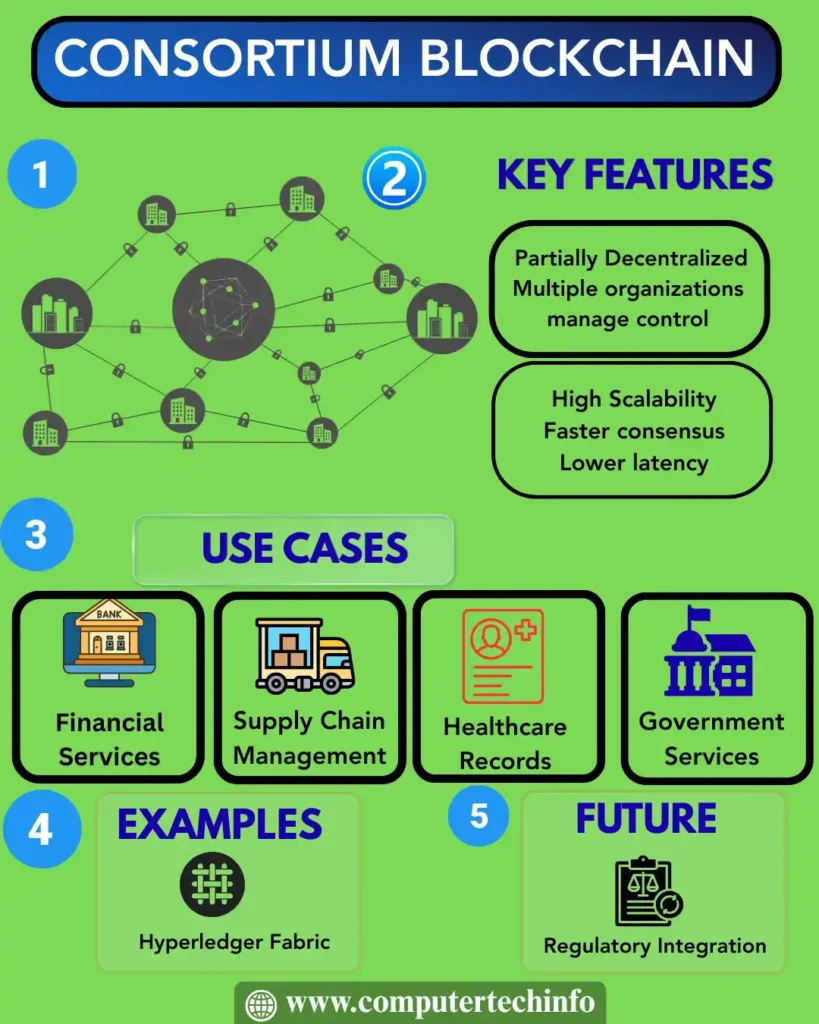
Key Features of Consortium Blockchains
1. Permissioned Access
Only people and organizations that allowed can join the network.
This builds the network more secure and private.
2. Shared Governance
No one organization is in charge of everything.
The decisions for the network are made by the members of the consortium.
3. High Security
The network is very secure because access is restricted.
The transaction data is also protected with encryption.
4. Faster Transaction Processing
This is because there are not too many validator nodes as there are on public blockchains. So transactions are confirmed quickly.
5. Improved Privacy
Business information shared only with the people who are supposed to see it.
This means that confidential data is kept safe and sound.
6. Scalability
Consortium blockchains can handle a lot of transactions than many public blockchain networks.
Some important things about this system are:
- It has controlled participation
- There are governing
- The system uses permission-based access
- It has efficient consensus mechanisms
- The system shared responsibility
- It also has enhanced privacy
- The system has Lower operational costs
- It is better at regulatory compliance
Advantages and Disadvantages of Consortium Blockchain
There are many benefits and drawbacks of using consortium blockchain, including:
Benefits Are:
The consortium blockchain is controlled by one party but it stops one company from having too much power. This control lets each member make their rules. They can cancel wrong transactions change balances and do other things to help work together with other companies that have the same goal. This works only if all members agree.
Also Read: Types of Blockchain Network Technology and its Examples and Use Cases
Validation is done by trusted members of a group of nodes. This makes it hard for someone to cheat by controlling than half of the network. If someone breaks the rules they get caught easily. Lose more than they gain.
The information from confirmed blocks is not shared with the public. However consortium members can see it. This makes the consortium more private. Clients of the platform feel more secure and confident.
There are no charges for transactions in a consortium blockchain. This is different, from blockchains.
Drawbacks Are:
The consortium blockchain can be at risk because that controlled by a people. When a few individuals are in charge it is easy to think that one or more of them might be dishonest.
Starting a consortium blockchain is tricky. All members must agree on how they will communicate with each other. Big companies are not as flexible as medium-sized enterprises so it takes a long time to set up a shared network among them.
Updating the communication rules is also hard. There might be more organizations involved than before and getting everyone on the page takes time.
We still have to assess the performance of the consortia mentioned below. We need to see if their approach really works.
Enterprises frequently resist collaboration which simply slows down development in the field.
Future of Consortium Blockchains
As companies work together across industries consortium blockchains will become even more important for digital change.
Some new trends are:
- Blockchain systems that work with Artificial Intelligence
- Connecting to the Internet of Things
- Networks that work across borders
- Smart contracts to automate businesses
- Managing digital identities
- Business assets in the form of tokens
- Watching supply chains to make them sustainable
These changes will make things work better be more open and have more trust, between organizations.
Consortium Blockchain Use Cases
1. Healthcare
There are people who take care of our health like hospitals and clinics and insurance companies. They can use something called consortium blockchains to keep our information safe and share it with each other. This helps make sure we get the treatment and reduces mistakes.
2. Finance
Consortium blockchains can make it easier to do business with money like when we buy things from countries. They can also help with sending money to countries. When lots of banks and financial companies use consortium to makes things happen faster and costs money. Consortium blockchains can help with trade finance and cross-border payments.
3. Identity Verification
Consortium blockchains are useful for identity verification. They can help stop identity fraud. Lots of organizations can use the network, like banks and governmental bodies and credit bureaus to share information about people’s identities and credit histories.
4. Real Estate
Consortium blockchains can be using for Real Estate transactions like when you buy or sell or rent a property. Many businesses can join the network, including real estate agents and property managers and title companies. They can share information about properties and transactions. This can help reduce fraud and make things more open and make administrative tasks easier.
5. Management of the Supply Chain
Consortium blockchains can monitor how products and commodities move along the Supply Chain.Many different types of businesses can join the network. These businesses can share information with each other in an open way including manufacturers, distributors, retailers and logistics firms of the Supply Chain.
Summing Up
Consortium blockchains are really good because they have a mix of being decentralized and controlled and collaborative. This makes consortium blockchains a great solution for businesses that want to use blockchain technology.
Consortium blockchains have a lot of things about them like people can trust each other more and everything is out in the open. They also make things easier. Keep data private. So consortium blockchains are going to change a lot of industries in the few years.
Also Read: What is Soft Computing? Applications and Techniques
We looked at some examples of consortium blockchains like R3 Corda and Hyperledger Fabric and IEBC, in this blog post. These examples show that consortium blockchains can be using in different industries. As consortium blockchains get better and work with technologies we will see even more new and exciting things happen soon with consortium blockchains.
If this article is valuable for you, then please share it along with your friends, family members, pet lovers or relatives over social media platforms like as Facebook, Instagram, Linked In,Twitter, and more.
Do you have any experience, tips, tricks, or query regarding on this? You can drop a comment!
Have a Nice Day!