Hello friends! So let us talk about what is general purpose registers with their example. And also learn about the special purpose registers in easy language. This is a unique content on the internet. With this post you will know all about the general-purpose registers without any problem.
What are General Purpose Registers?
GPRs stands for (General Purpose Registers) are very important components in CPU that use in many several purposes including like: storing data, memory addresses, and operands for arithmetic and logical operations. They work as a fast memory for data and command needed by the CPU.
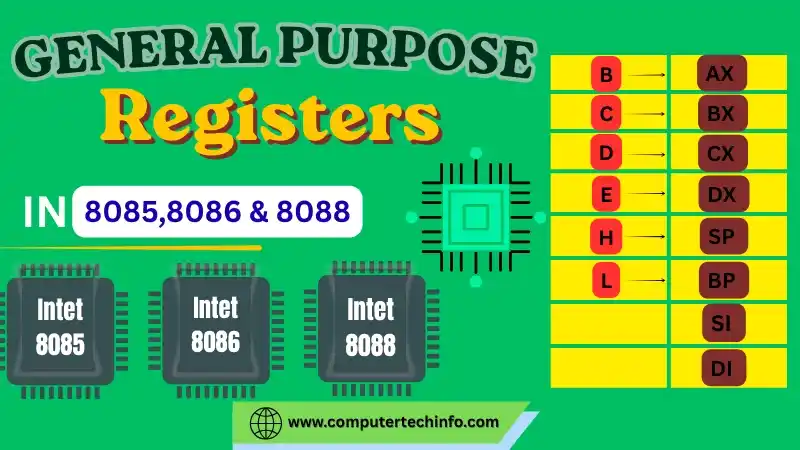
In their x86 architecture, eight GPRs are using, such as AX, BX, CX, DX, SI, DI, BP, and SP. These registers use to keeping storing and modifying data, executing all the arithmetic and logical operations, as well as facilitating memory addressing.
Also Read: What is IGMP? | Internet Group Management Protocol
The GPRs work opposite to SPRs, because the GPRs can be using many different task and store temporary data while the CPU is working. But the other hand the SPRs work is different they can do only do one fixed job. So, they cannot be using for every task.
General Purpose Registers Functions
General-purpose registers (GPRs) can do many several functions and operations in your CPU’s architecture. Here are some key functions of general-purpose registers, including like:
Data Storage: GPRs can store temporary data in computer during program execution, and providing fast access for the CPU to perform arithmetic and logical operations in your computer.
Arithmetic Operations: GPRs used in to do arithmetic operations like: addition, subtraction, multiplication, and division. They store operands and outputs of these operations.
Logical Operations: GPRs make easier for your logical operations like AND, OR, and XOR, helping the CPU to make decisions based on conditions.
Memory Address Calculation: GPRs have capacity to hold memory addresses or offsets, helping in the calculation of addresses for data retrieval and storage in RAM of the system.
Function Return Values: GPRs Many times store return values from function calls, allowing the CPU to pass details back to the calling code.
Loop Counters: Some specific registers, like ECX in x86 architecture, are commonly using in loop counters, and enables iterative operations.
Shift and Rotate Operations: GPRs helps the CPU in shifting and rotating bits within data, and help in to support various bitwise operations.
Context Switching: During a context switching between different program or processes, the value stored and saved in GPRs and restored to maintain the state of a process of computer.
Pointer Operations: Some GPRs, like EBX in x86, may work as base pointers for access the memory or hold memory addresses.
Temporary Storage: GPRs work as temporary storage for medium values, supporting in complex calculations and data modification.
General Purpose Registers in 8086 with Examples
The Intel 8086 introduced in 1978 with microprocessor has 8 General Purpose Registers that can store information/data, help access memory, and perform arithmetic calculations. And registers can use as a whole 16-bit register.
Also Read: What is ICMP (Internet Control Message Protocol)? Full Guide
Its importantgeneral-purpose registers in the 8086 are AX, BX, CX, and DX.
AX (Accumulator)
Now we are discuss about the AX can used as 16-bit register or as two different8 bit registers, AH (high byte) and AL (low byte).
Example: It here example of MOV AX, 1234h; Move the hexadecimal value 1234h into AX
BX (Base)
As we know AX, BX is using as few as a 16-bit register, BH (high byte) and BL (low byte).
Example: Now we discuss about the example of MOV BX, 5678h; Move the hexadecimal value 5678h into BX
CX (Count)
We are exploring the CX works as a counter and using as a 16-bit register or as two different 8-bit registers, CH (high byte) and CL (low byte).
Example: You know example of MOV CX, 10; Move the value 10 into CX
DX (Data)
Now we are going to discuss in this point DX is usedlike general value operations and can also uses as a 16-bit register, DH (high byte) and DL (low byte).
Example: We discuss example MOV DX, 0ABCh; Move the hexadecimal value 0ABCh into DX
Other General-Purpose Registers (SI, DI, BP, and SP):
SI register is the source index register are using in to point the source in some string-related operations.
DI register is the destination index register and uses to point to the destination in some string-related operations.
BP register is the base pointer and is primarily using in accessing the parameters passed by the stack.
SP register is the stack pointer and points to the topmost element of the stack.
General Purpose Registers in 8085 with Examples
Let we discuss about the 8085 microprocessors have a six general uses registers (GPRs), symbol by B, C, D, E, H, and L. These registers are getting to pair to form three register pairs: BC, DE, and HL. And each of this register is 8 bits wide, and the register pairs are 16 bits wide.
Also Read: What is DHCP (Dynamic Host Configuration Protocol)? Guide
There are fewgeneral-purpose registers in the 8085 microprocessors:
- B Register: The high-order byte of the BC register pair
- C Register: The low-order byte of the BC register pair
- D Register: The high-order byte of the DE register pair
- E Register: The low-order byte of the DE register pair
- H Register: The high-order byte of the HL register pair
- L Register: The low-order byte of the HL register pair
Features of GPR of 8085 include:
This all registers are easy to access directly by the arithmetic and logical unit, allowing for capable processing of data.
The Accumulator Register is the CPU’s default destination for storing the output of most arithmetic calculations.
Examples Are:
Moving Data between Registers
MOV B, A; Move the contents of the accumulator (A) to the B register
MOV C, B; Move the information of the B register to the C register
So, in this example, the MOV commands are using to transfer information between the accumulator and the B register and from the B register to the C register.
Register Pair Operations
MVI H, 0AH; Load the immediate value 0AH into the H register
MVI L, 05H; Loads the immediate value/data 05H into the L register
Here, the MVI (Move Immediate) command is using to load medium value into the H and L registers, forming the HL register pair.
Addition of Register Pairs
MOV B, 10; Load value 10 into the B register
MOV C, 20; Load value 20 into the C register
ADD B;add the contents of the B register to the accumulator
This example proves to load data into the B and C registers and then adding the contents of the B register to the accumulator.
General Purpose Registers in 8051 with Examples
The 8051 microcontrollers have four banks of general-purpose registers, labelled as B0, B1, B2, and B3, each of this containing eight registers in under the rang from R0 to R7. These registers are using to store the result of arithmetic and logical instructions, and they are of 8 bits in size.
Also Read: What is Address Resolution Protocol (ARP)? How to Work with Examples
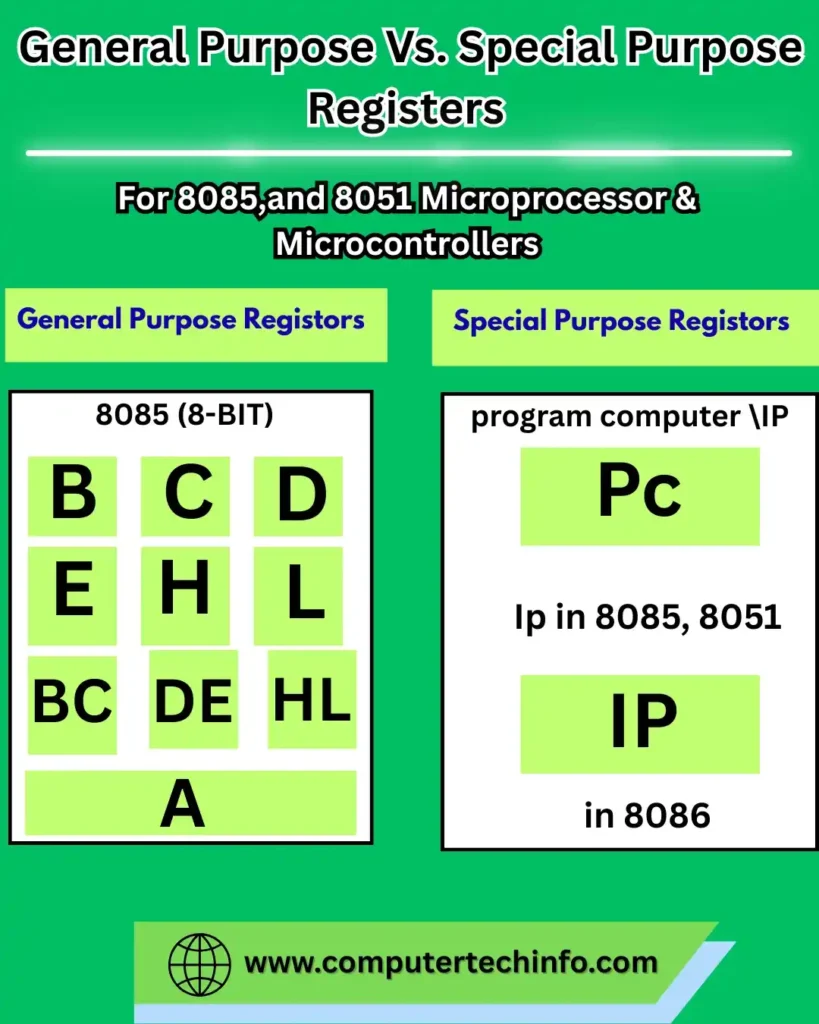
As we know about the general-purpose registers; the 8051 also has other generally used registers such as the accumulator (A), B, data pointer (DPTR), and program counter (PC). These registers are using for various purposes, such as storing information, performing mathematic operations, and holds temporary values.
R0 and R1
- These are 8-bit registers using for general-purpose storage.
- They can also use in arithmetic and logical operations.
Example:
- MOV A, #50; Load the accumulator A with the value 50
- MOV R0, A; Move the contents of A to R0
- ADD A, R0; Add the contents of R0 to A
R2 and R3
- These are also 8-bit registers using for general-purpose storage.
- They can also use similarly to R0 and R1.
Example:
- MOV A, #30; Load the accumulator A with the value 30
- MOV R2, A; Move the contents of A to R2
- SUBB A, R2; Subtract the contents of R2 from A with borrow
Special Purpose Registers
Special Purpose Registers (SPRs) is a special register inside the central processing unit (CPU) of the computer system that helps to work dedicated functions instead of general-purpose registers.
These registers are created to control specific works of the processor’s behaviour, and manage system configuration, or supporting certain operations. The exact set of special purpose registers can vary between different CPU architectures.
There are few common types of special purpose registers with examples:
Program Counter (PC)
Purpose: The main purpose is to keep tracking of the memory address of the next value to be executed.
Example: In the x86 architecture used the Extended Instruction Pointeras the program counter.
Stack Pointer (SP)
Purpose: If, we talk about the stack pointer points to the topmost level of the stack in memory, used likecontrolling subroutine calls and local variables.
Example: Now we explore the example of Stack Pointer x86 architecture used (Extended Stack Pointer) as the stack pointer.
Status Register (Flags Register)
Purpose: Stores many condition status outputs from arithmetic and logical operations.
Example: In this x86 architecture has the status register, with bits representing conditions like: zero, carry, overflow, etc.
Instruction Pointer (IP)
Purpose: In this point we are discuss about the similar to the program counter; it holds the memory address of the next command to be executed, particularly in the context of x 86 real modes.
Memory Address Register (MAR)
Purpose: Holds data fetched from or to be written to memory.
Example: Used to manage the memory read or write cycle to temporarily store data being transferred between the CPU and memory.
Machine Status Register (MSR)
Purpose: Controls many machine-specific operating modes and settings.
Example: Found in PowerPC architecture, the MSR might have bits controlling interrupt enable/disable, floating-point unit modes, and other machine-specific settings.
Control Register (CR)
Purpose: As we know contains control information for the CPU, such as enabling or disabling certain features.
Example: We are exploring the example of control register ifx86 architecture has CR0 and CR4, which control features like paging, protection, and task switching.
Debug Registers (DR)
Purpose: You know that used like hardware debugging, allowing breakpoints and watch points to be set.
Example: You know about the example of x86 architecture has DR0 to DR7, which can be configured for debugging purposes.
Floating Point Control and Status Registers (FPSCR)
Purpose: As we know run floating point operations and cache status flags.
Example: Now we will discuss about the example of FPSCR powerPC architecture uses FPSCR like floating point control and status information.
Vector Registers
Purpose: As we know you can usedfor SIMD (Single Instruction, many Data) operations.
Example: Now we discuss example architectures like Intel’s x86 (with SSE, AVX), ARM NEON, or IBM’s AltiVec, vector registers hold many data elements for parallel processing.
Difference between General and Special Purpose Registers
The difference between of General-Purpose Registers (GPRs) and Special Purpose Registers (SPRs):
Also Read: Reverse Address Resolution Protocol and its Complete Guide
| Aspect | General Purpose Registers | Special Purpose Registers |
| Function | Used for general value modification | Created for only specific tasks and operations. |
| Versatility | This versatile in nature, can be used for various tasks | Work on specific tasks only, dedicated roles within the CPU |
| Number | Usually multiple (e.g., 8 to 32) | Only fewer, with specific functions and operations |
| Access by Programmers | Accessed directly in low-level languages | Accessed Indirectly through compiled code. |
| Types | May include integer and decimal-point registers | Program Counter (PC), Stack Pointer (SP), Status Register, etc. |
| Usage in Arithmetic Operations | Used for general mathematical operations | Flags in Status Register points outputs of operations |
| Role in Memory Addressing | Can be used for holds memory addresses | Special Purpose Registers like Memory Address Register (MAR) and Memory Buffer Register (MBR) are used for memory operations and functions. |
| Impact on Program Performance | proper use can improve performance by decreasing access memory | Important for control flow, interrupt handling, and managing program properties |
| Context Switching | Now we are discussing about Information needs to be saved and restored during context switches | Part of the information that needs to be saved and restored during context switches |
| Examples (x86 Architecture) | EAX, EBX, ECX, EDX | Program Counter (PC), Flags Register, Stack Pointer (SP) |
| Programming Languages | Accessed only by the low level and assembly languages | Indirectly read by the high-level languages between compiled code when generate. |
FAQs (Frequently Asked Questions)
Final Words
So, we hope you learn many things form this article and educated about what is general purpose registers with their example; as well as special purpose registers with easy language.
Also Read: Blockchain Private Key QR Code and its Origin, Risks | How to Generate It
If this article is valuable for you, then please share it along with your friends, family members, pet lovers or relatives over social media platforms like as Facebook, Instagram, LinkedIn,X, and more.
Do you have any experience, tips, tricks, or query regarding on this? You can drop a comment!
Have a Nice Day!