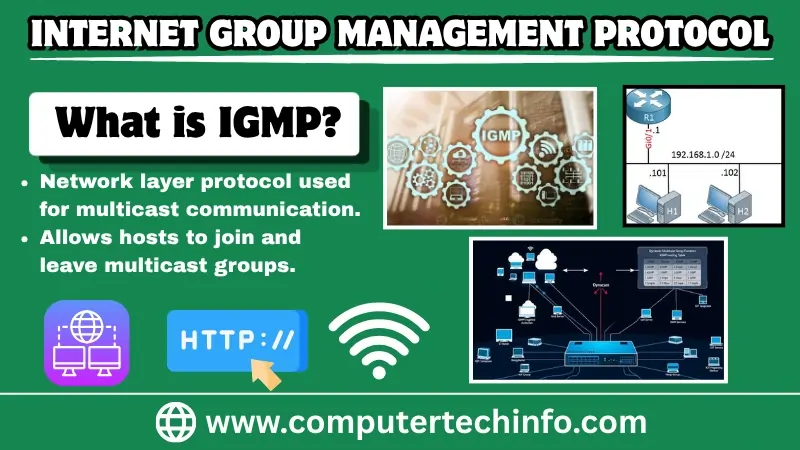
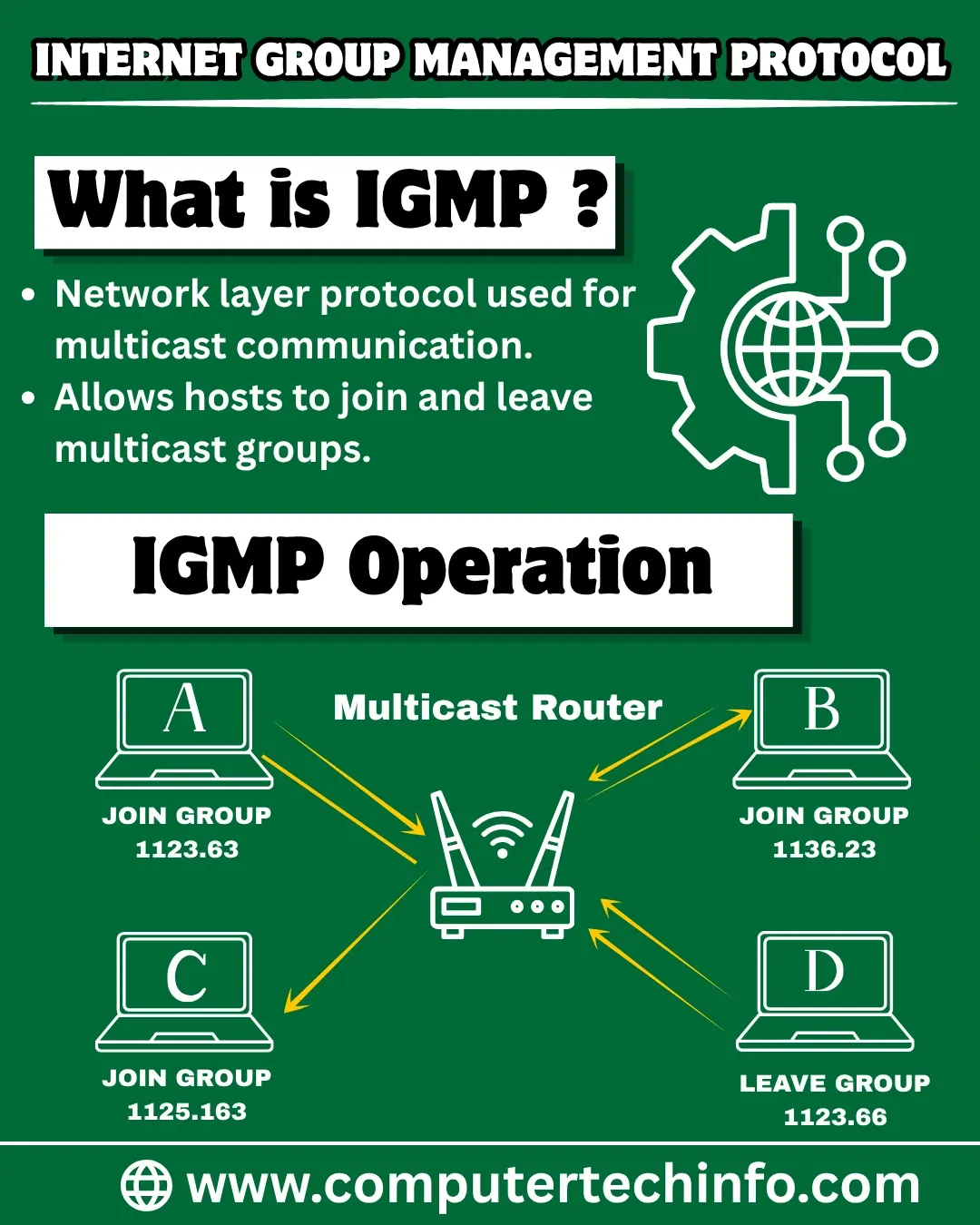
(IGMP) Internet Group Management Protocol is a network service protocol performed in multicasting. The main goal of this system is to manage the hosts/users membership in the group which called Multicast group.
The IGMP protocol work in between the host/user, which is active in the multicast group and multicast router.
Here are mainly 3 versions of the IGMP protocol
- IGMP VERSION v1 (first IGMP version).
- IGMP VERSION v2 (second IGMP version).
- IGMP VERSION v3 (latest IGMP version).
So in this article, we will talk about how the IGMP protocol work and manage. How active and inactive the membership of the multicast group. And also discuss the types of the messages use is the IGMP protocol for communication.
IGMP Versions: A Historical Overview
So let as talk about the old version of the IGMP protocols. And talk about improvement in other version.
Also Read: What is ICMP (Internet Control Message Protocol)? Full Guide
IGMPv1: This is a first IGMP version which defined in RFC 1112. This version is mainly use in the queries and reporting messages. Hosts/users can leave the Multicast group by not large responding to the routers.
IGMPv2: this version introduced in RFC 2236, in this version additional feature is Leave Group message feature. In which the host/user can report and leave the multicast group by the message like, “I leaving the group” And the router follow the command and remove you from the Multicast group.
IGMPv3: It defined in RFC 3376, providing the best feature that is (SSM) Source- Specific Multicast. With this hosts/users can choose the specific source in the multicast traffic .And they want that source. This make traffic list Update faster and enhance the security system.
How Does IGMP Work?
Firstly connect the computers and other devices with the network and then use IGMP When you want to join the group. A router check your query with the help of the IGMP listens and IGMP transmissions.And understand the devices connected to the multicast group.
IGMP uses IP addresses for the multicast traffic. This multicast have range of the IP addresses the range is approx is (224.0.3.2 to 239.255.263.253.).
And each of the multicast groups shares that IP addresses to the network. And when the router receives that playlist packet directed at the shared IP addresses. It will copy that packets and sent the copy to all the member of the Multicast group.
Also Read: What is DHCP (Dynamic Host Configuration Protocol)? Guide
IGMP can change the multicast group in any time. And the devices can join, and leave the group by a single message.
IGMP directly work on the IP addresses on the top. Special think is IGMP packet have both IGMP and IP headersame like a ICMP. And IGMP not uses transport layer of the protocol like a TCP.
Internet Group Management Protocol Messages
If we categorize the IGMP Messages then there are two types of IGMP messages the IGMP membership report message and IGMP membership query messages.
We have some types of the IGMP messages there are mainly 3 types of messages.
Membership Query
This type of message is used tosent the query by the query router of the network to check about the active member in the multicast group. The membership Query also classified in 3 types:
General Query Message: In this general query message the router check host about all the multicast groups the host is involved in or not.
Group-Specific Query Message: In this query message the router checks the host/user. They are interested in the specific multicast group.
Group-Source Specific Query Message:In this query message the query router checks the host/user.It still interested in the specific multicast group and coming from specific source.
Membership Report
The hosts/user can send the query message by their devices to send a report to stay in the multicast group a want to leave the specific source group.
Leave Group
This message specifically used when the host/user want to leaves the multicast group.
When is the Internet Group Management Protocol Used?
The main role of the IGMP is that to transfer the same date to the multiuser present in the multicast group at the same time with help of the using the IPv4 networks. The communication protocol happens when the Multicast Transmissions use IPv4 networks to deploy the data.
Firstly they copy the files of the data and then send the data stream to individually with this data stream lead quickly. You can sent to that host which response us.
Benefits of Using IGMP
Efficiency of the Bandwidths: Only the multicast group members receive the IGMP traffic and reducing the congestion in the networks.
Also Read: What is Address Resolution Protocol (ARP)? How to Work with Examples
Maintain Scalability: The best think is that multicast efficiently deliver the large amount of Receivers.
Optimization of the Resources: they reduce the load from the server to sends the member single stream not the multi stream mainly like (one to one communication).
Supports in many Applications: This is suitable for much Applicationlike:
Live streaming, online gaming platform etc.
Common Mistakes and Troubleshooting
Configuration Mistake: The misconfiguration in the settings of the IGMP cans effects on the multicast traffic to reaching its intents receivers.
Firewall Problem: Sometimes the Firewalls blocks the IGMP messages, stops the host/user to join the group.
Router Issues:The router hasworked properly to configure and ensures traffic forwarded correctly.
Versions Mismatch: we have to ensure that router and hosts support the same version of the IGMP.
IGMP Different B/W ICMP
| Feature | IGMP (Internet Group Management Protocol) | ICMP (Internet Control Message Protocol) |
| Purposes | They Manages The Multicast Group. | Reports Network Errors And Check It. |
| Function | Give The Permissions To Devices. ToLeave And Join The Group. | Send Only The Error Messages And Show The Network Information Of The Status. |
| Network Type | Have A Multicast Communication | Have A General Network Communication |
| Protocol Layer | Network Layer | Network Layer |
| Commonly Use | Video Streaming, Online Broadcasting | Ping, Trace- Route, Error Reporting |
| Message Types | Membership Query, Membership Report, Leave Group | Echo Request, Echo Reply, Destination Unreachable |
| IPv4 Support | Yes | Yes |
| Main Goal | Efficient Multicast Traffic Delivery | Network Troubleshooting And Diagnostics |
Applications of IGMP
Streaming on media: It delivers the one-to-many or many-to-many in the video and in audio.
Also Read: Reverse Address Resolution Protocol and its Complete Guide
Online Gaming platform: That allows the multi player support to exchange the game state and updates in that real time.
Online meetings: It will support the large group of the communication for online meetings.
Future of IGMP
So, we see that streaming services, online meetings and the real time communications are growing very well. So the IGMP is very useful in future also.
Emerging Technologies:
- Smart Cities
- IoT Networks
- Cloud-Based Broadcasting
- Virtual Reality Streaming
- Large-Scale Video Conferencing
IGMP will continue play a vital role in efficient multicast communication.
FAQs (Frequently Asked Questions)
Final Words
IGMP is made for manage the multicast communication efficiently in the IPv4 networks, and they enable’s the router to manage and maintain the membership group information in accurate manner.
Also Read: Blockchain Private Key QR Code and its Origin, Risks | How to Generate It
And protect the unnecessary network flooding and check that the multicast traffic is reach to their active receivers only.
If this article is valuable for you, then please share it along with your friends, family members, pet lovers or relatives over social media platforms like as Facebook, Instagram, Linked In,Twitter, and more.
Do you have any experience, tips, tricks, or query regarding on this? You can drop a comment!
Have a Nice Day!