Hello Friends! Today, we are going to explain about what is SONAR system and its different types? Involving with, how does work SONAR technology with ease.
Finally from this post, you will get to know completely about SONAR and its Working without any hassle.
What is SONAR Technology?
Today we discussing in this topics, what is SONAR (Sound Navigation and Ranging) technology? As we know Sonar is a technique that uses sound waves to find and locate objects underwater. It works by emitting sound waves, or pulses, that bounce off of underwater objects and return to a receiver.
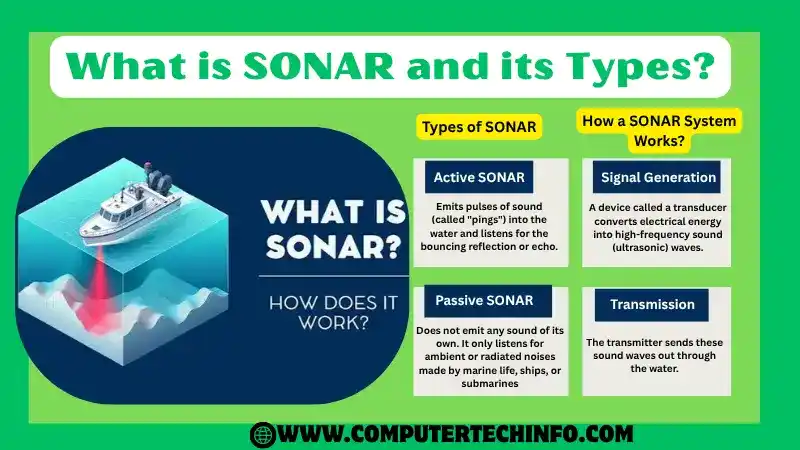
By investigate the time it takes for the sound wave to travel to the object and back, as well as the frequency and power of the returned signal. And, SONAR systems can create detailed images of the underwater environment.
Also Read: Applications of SONAR | Uses & Examples of SONAR Technology
SONAR technology is using for a variety of purposes, including navigation, mapping, and search and rescue operations. It is commonly also using in submarines, ships, and underwater robots to detect other vessels, underwater hazards, and geological features. Additionally, SONAR is using by scientists to study marine life and underwater ecosystems.
Types of SONAR System
Let we talk about the main objective of using SONAR was to detect the objects under the surface that could prove challenging to ships and submarines. Further, the World War brought important enhancement that pushed next importance of warfare submarines and the underwater surveillance.
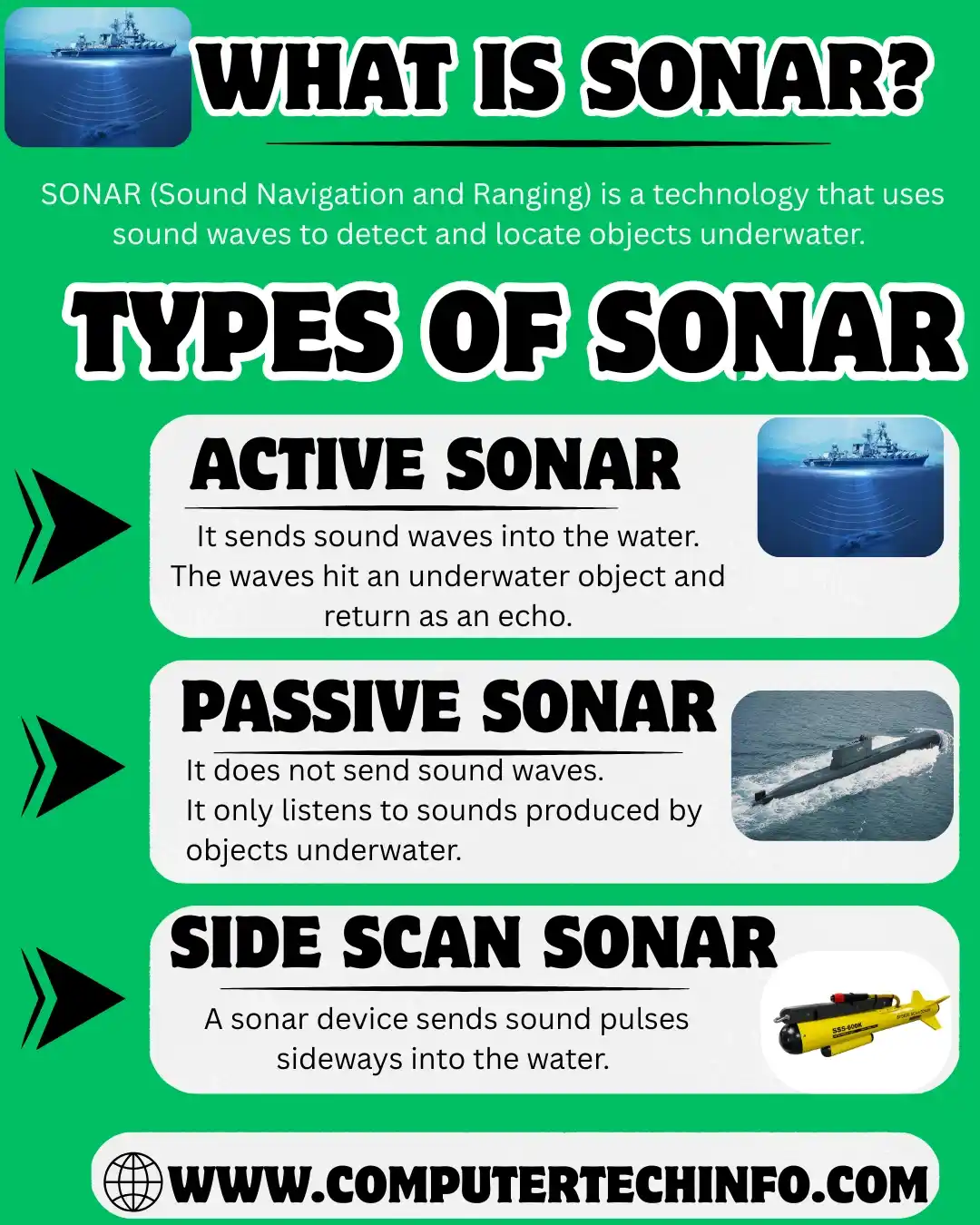
On the behalf of this enhancement, SONAR technology has two different variants like as Active and Passive SONAR. Below shown each one, you can check them:
Active SONAR:
As we know active SONAR comprises a sound projector and a receiver to identify the range, bearing and relative motion of the target point. Acoustic projector produces the sound wave that transmits outward and reflected back with helping of target point. The receiver grabs these signals and then analyses this reflected signal.
You know about the best example of active SONAR system are submarine vessels. This is because; submarines are able to transmit acoustic energy and then finding out the objects in the vicinity through time delay in between the acquisition of echo.
Also Read: Advantages and Disadvantages of SONAR | Pros and Cons
The Deep Trekker ROVs use the active SONAR system that emits out the sound waves at the specific frequency, then listens for how long it takes for these sound waves to back return after getting to bounce off object in the underwater and the seafloor. The multibeam imaging SONAR system applies the multiple beam of sound to color a picture of what’s at the front of the ROV.
Passive SONAR:
Let we talk in this about the Passive SONAR system allows to detect of sounds that are generating by a moving objects otherwise marine vessel. Ships, Submarines, and aquatic animals’ generate the distinct sounds. These sounds are producing from the different target objects, which are going to use for detection and estimation of target point.
But, passive SONAR is unable to determine the range of target object unless it is applying in the conjunction along with other devices.
LOFAR (Low-Frequency Analysis and Recording) and DEMON (Demodulation of Envelope Modulation On Noise) techniques are applying for processing the received signals. Mostly, passive detection is utilizing the study of marine life.
Working of SONAR Technology
Here we talk about the, we will try to explain the working of SONAR system with diagram.
Sonar working enables with ultrasonic waves, in which receivers and transmitter are utilizing in the technology. All devices are embedding into the ship, then ultrasonic waves and ultrasound are producing by the transmitter.
Also Read: What is Web Server? Definition, Types, Examples, Working, & Uses
These emitted waves are getting to travel across the water. After this, these waves pass via water and hit objects submerged otherwise on the seabed. Whenever, these waves will be strike with any objects and seabed, and they will reflect.
As the outcome, the receiver gather these reflected waves; furthermore ultrasonic waves will convert into electrical signal that are getting to study to determine the underwater cases and obstacles.
The distance (d) of the under-water object can be calculated from the time (t) taken by the echo to return with speed (v) is given by 2d = v × t. This method helps to measure distance is also called the ‘echo-ranging’.
Architecture of SONAR System
Now we talk about the few components are using in the working structure of the SONAR system like as:
Receiver: It is a detector device that helps to detect and grabs the echo coming from the transmitted waves. They are coming from the different kinds of objects and gets analyzing them to identify the distance of objects and several such things.
Also Read: Consortium Blockchain and its Diagram, Features, Use Cases, Examples, & Future
Transmitter and Emitter: These devices help to generate the ultrasonic sound waves, and then transmit them to other directional of the ship and submarines.
Transducer: This is main element of the SONAR system that constructed with piezoelectric material. So, it has capability to produce the electric potential. Whenever the voltage is using to the Transducer then it oscillates making the acoustic pulse. But apposite it, if pressure is applying over the Transducer, then it also generates the electric signal.
The received signals make the pressure on the Transducer. Hence, this processing of converting electrical energy to sound energy and back is known as the ‘Transduction’.
Synchronizer: This component assists to making the coordination of transmission and reception to serve the system in unison.
Control Unit: With the help of this unit, the whole system can easily get control. Moreover, this unit also assists for making of transmission, processing and reception along with signals.
Display Unit: This unit appears the all processed data into visual form. And, this display is a scanned picture or PPI image (Planned Position Indicator).
Ultrasonic Waves: These sound waves have frequency more than 20 kHz.
Interesting Applications of SONAR:
SONAR technology has a wide range of applications in various fields. Here are some of the common applications of SONAR; there are explain in brief detail:
Navigation and Mapping: SONAR is using for navigation and mapping purposes, particularly in marine environments. It helps ships and submarines to detect underwater obstacles and map the ocean floor.
Search and Rescue Operations: SONAR technology is using to locate and recover lost objects and people in water bodies. It is commonly also using in search and rescue missions, particularly for finding and recovering sunken ships and aircraft.
Fishing: Let us start in this point talk SONAR is widely applying in the fishing industry to locate schools of fish. It helps fishermen to control the size, depth, and density of fish people, let them to improve their catch.
Defence: SONAR can use for defence purposes, particularly in submarine warfare. It enables submarines to detect and locate other vessels and underwater mines, providing a critical advantage in combat situations.
Features of SONAR System
There are some features of sonar, include:
Detection Capabilities: Let start us features of Sonar can detect the existence and location of underwater objects, like submarines, ships, rocks, and marine life.
Also Read: Blockchain Private Key QR Code and its Origin, Risks | How to Generate It
Range and Depth Capabilities: Sonar can detect objects at varying distances and depths, depending on the type of sonar used.
Imaging Capabilities: Few sonar devices are capable to create images of underwater objects that allowing for more detailed analysis and identification.
Communication Capabilities: Sonar can easily use in underwater communication, allowing for messages to send and receive between underwater devices or between underwater and surface devices.
Navigation Capabilities: Sonar is also using for underwater navigation, allowing for accurate positioning and movement tracking.
Multi-functionality: You know about the Sonar can use for a types of applications, involve the military, commercial, scientific, and recreational basis.
Durability: In this point, Sonar devices allow to with stand harsh underwater environments, involve the high pressures, extreme temperatures, and saltwater waste.
FAQs (Frequently Asked Questions)
Summing Up
Today we discussed in this content about SONAR system and its types; involving with, how does work SONAR technology with ease.
If this article is valuable for you, then please share it along with your friends, family members, pet lovers or relatives over social media platforms like as Facebook, Instagram, LinkedIn,X, and more.
Do you have any experience, tips, tricks, or query regarding on this? You can drop a comment!
Have a Nice Day!